Showing posts with label romance. Show all posts

Friday, January 02, 2026

Oldies But Goodies {Put This One on Your TBR List} Book Review: The Saint of Steel Series by T. Kingfisher by Karen S. Wiesner


Oldies But Goodies

{Put This One on Your TBR List}

Book Review: The Saint of Steel Series by T. Kingfisher

by Karen S. Wiesner


Beware potential spoilers! 

To describe T. Kingfisher's medieval fantasy The Saint of Steel series as romance is a bit off the mark. No doubt it has lateral shoots toward it but those tendrils into the genre are anything but conventional. The language and love scenes are unexpectedly crude, the way erotica can sometimes be, though all volumes frequently dip into the (frequently eye-rolling) tender mawkishness of traditional romance offerings. I suspect strongly that the author intended exactly this unorthodox straddling of categories when she was writing it. 

Whatever its classification, for the most part, I found it to be a breath of fresh air. Full disclosure: For all intents and purposes, I stopped reading romances (other than the young adult variety) about twenty years ago. I can't really say that was a conscious decision. More that I'd expanded past the romance-heavy books that dominated the reading of my twenties and early thirties. And, admittedly, I no longer cared for the requisite love scenes that were so much a part of this genre. I discovered another nice thing about audiobooks is that you can fast-forward past sections in 15-second intervals. I did that a lot with these. In any case, it was a bit strange for me to take up a romance series--unconventional as this was--again after all this time away. 

Once I'd finished with Kingfisher's audiobook of A Wizard's Guide to Defensive Baking (I reviewed it recently on this blog), the only available audiobooks by this author on my library app were these four books in The Saint of Steel series. Weirdly, all of them were available to check out there and then, so I was able to listen to them back-to-back. The fact that they were readily obtainable when none of her others were made me wonder if they weren't any good. Luckily, I found that wasn't the case. I also learned that when something is "DRM free", as I think this series is, it means that unlimited electronic copies are distributed. No waiting lines! Nice for readers, probably not so much for the author or publisher. 

The premise of this series is that an order of berserker paladins loses the Saint of Steel they serve when he dies. Unthinkably--to me anyway--in this fictional medieval time period the series is set in, these saints are venerated as gods; in fact, the words "saint" and "god" pretty much mean the same thing here. After his death, his followers go on a mad rampage of death before they're broken. That's covered in a short prologue in Book 1. Years later, the seven survivors have been taken into the service of the (irreverent but amusingly so) Temple of the Rat, made up of lawyers, healers, and other community service workers. Here, they can again do good. 

By nature, paladins are selfless, chivalrous, and honest to a fault. However, these knights are forever in danger of losing themselves to the berserker rage (called the black tide) they can't control once its unleashed. I loved how natural the world building in this medieval setting is in the author's hands. She does medieval effortlessly, as if she herself actually lives in that time period. 

There are four books in this series:

Paladin's Grace, Book 1 (2020)

Paladin's Strength, Book 2 (2021)

Paladin's Hope, Book 3 (2021)

Paladin's Faith, Book 4 (2023)


In Paladin's Grace, the knitting paladin Stephen is the focus. Grace is a perfumer he rescues one night and then the two become embroiled in a conspiracy plot against the crown prince as well as investigating necromantic serial killings in which the victim's heads are chopped off; black magic clay heads are then implanted into the corpses to make an army of monsters. 

This story had some clichéd romantic elements. Stephen was such a do-gooder he was always worrying about losing control whenever he and Grace found themselves in a compromising sexual situation. Frequently, that led to sex between them being tabled, which got a little stale after a while. Grace is also the victim of a philandering husband who made her believe she was frigid and so she spends a lot of wasted time pushing Stephen away on that premise. The first actual love scene was a little icky for me--as far from romantic as it gets. I wanted to shout, Please, close the door! I believe the author wrote it the way she did to avoid all potential for purple prose or swooning. She may have gone a little too far on that point. I learned after that to fast-forward to get past these excruciating scenes. That said, the rest of the romance and suspense plotlines were, at turns, fun, funny, sweet, and even heartwarming. The happily ever after between Stephen and Grace was, fittingly, out of the ordinary for a romance novel as well, in that the couple didn't have a picket fence and 2.5 kids in their future. They would both continue as they had been, only now they were together. I really liked that Grace's best friend Marguerite was a very avant garde character. The reader didn't know what she might do next. I also liked the introduction of a race of talking badgers that are a part of human society in this medieval world. 

Book 2 in the series, Paladin's Strength, takes up paladin Istvhan's (mentioned in Book 1) story. He's paired with Clara, a very large (nearly his own considerable size), capable woman who's a nun from a secretive order. Clara is hiding something shocking and intriguing that really adds something to the story. Her sisters have been kidnapped. She doesn't know why, but she intends to find out. Istvhan's company--that she originally thought was a band of mercenaries--helps her and, along the way, finds out that the necromantic serial killer from Book 1 is still on the loose. 

There's also a gnole in this story, as there was in Book 1 (I don't think it's the same one) who accompanies Istvhan's company. I loved this interesting, unexpected character. Additionally, we got to revisit Stephen and Grace's happily ever after, which was nice. I liked the main characters, their amusing repertoire, and the romance that seemed joyfully inevitable despite their circumstances. However, as in Paladin's Grace, the angst that Istvhan and Clara go through about whether they should be allowed to fall in love and have sex with each other gets really annoying with such a long book. Teenagers are less angsty than Kingfisher's couples in this series. At one point (64% into the 16-hour audiobook), Clara thinks to herself, What's wrong with me? I should have been riding this man until we both walk funny. That about sums it up. Just do it already! The author also has far too many albeit plausible (but still annoying) interruptions getting in the way of sex. The overwhelming build-up tends to make the actual event disappointing when it finally comes. I'm beginning to fear the entire series might suffer from this particular malady. 

In general, I enjoyed this story and its characters very much, though it was far too long. There were two external plotlines and both got the full treatment. While I think they were both well done, the book seemed nevertheless excruciatingly endless. The angst could have been blessedly cut and taken with it a good one or two hundred pages. 

The gay paladin, Galen, mentioned in Book 1 and having played a large role in Book 2, is in the spotlight in Paladin's Hope. In the first book, we learned that he's struggled more with survival after the Steel Saint's death than the others. His nightmares used to end in a berserker rage, but he's found that being on the road helps temper the bad dreams quite a bit. He now goes weeks or longer without having one. 

In this story, Galen is paired with a lich-doctor (a physician that works among the dead, determining causes of death for city investigations) named Piper. Piper has a useful, intriguing skill that aids him in his profession. He calls it "wonder working"--when he touches a dead body, he can see what happened the last few seconds of their life before death. When a tenacious and brave constable gnole decides there are too many mysterious bodies piling up, he enlists Piper and Galen's to help him find the source. That's the only suspense plotline in this book, and that made it a lot shorter to get through, which was nice. Unfortunately, Galen and Piper are just as tormented with worry as the previous couples, so fast-forward, fast-forward, fast-forward! 

Side note: The Saint of Steel series books are also associated with some of Kingfisher's other titles set in the same medieval fantasy world. The umbrella series is referred to as "The World of the White Rat" and includes The Saint of Steel as well as Clocktaur War (with two books) and the novel Swordheart. I intend to read all of those soon and maybe review them here. The reason I mention this is because, in this story, Galen talks about how he'd had some experience with "wonder" (mechanical and possibly magical) doors and machines. The two stories in the Clocktaur War may tell this story Galen references. I'll have to see. Early in Paladin's Hope, Galen, Piper and the gnole are forced behind a wonder door, into a labyrinth filled with deadly traps they'll have to get through to escape. 

In the course of the book, readers briefly get to see the happily-ever-afters of the two previous couples, which I enjoyed. I liked the fully-fleshed out characters and the new mystery plot in this tale that's nicely focused without too much expansion from that point. 


The final book in the series, Paladin's Faith, features Marguerite and paladin Shane, her bodyguard. She's trying to escape a former employer who's part of a powerful organization that wants her dead. Along the way, the couple have to dodge a demon-led cult that's out to get them. Additionally, Marguerite, Shane, and another paladin--a female named Wren--go undercover to hunt for an artificer who's crafted a device that could devastate the world. Also, though I never really thought about it before, the suspicious death of the Saint of Steel that all these paladins served is brought up in this book as yet another suspense angle. 

Again, this story was far too long and overburdened with subplots upon subplot. Combine this with yet another angsty romance between two people who spend far too much time telling themselves they can't anything with the other, and it's a surefire recipe for overload. Sigh. The female paladin Wren, who's like a sister to Shane, added an interesting viewpoint to this tale. Despite the negatives, I did enjoy the overall story, the compelling cast of characters, and the multi-faceted mysteries were capably handled from start to finish. 

Note that according to the author, though there are seven surviving paladins, these are the only four stories she intends to write (well, Wren is a paladin and a good chunk of her story was told in this last book, so perhaps we can say five stories were told within the four books, leaving potentially two untold), though further entries aren't out of the realm of possibility in the future. I expect Kingfisher didn't initially anticipate writing more than a trilogy with The Saint of Steel but Marguerite probably got a lot of requests for a story of her own. I for one would have felt disappointed without finding out what happened to her after Book 1. 

To sum up, if you're looking for something unusual and unconventional in your romance reading, this series is certainly worth your time. Beware the teenager apprehension you'll get around every corner between the couples, but, alas, that's what audiobooks and fast-forward buttons are for. 

Karen Wiesner is an award-winning, multi-genre author of over 150 titles and 16 series.

Visit her website and blog here: https://karenwiesner.weebly.com/

and https://karenwiesner.weebly.com/karens-quill-blog

Visit her publisher here: https://www.writers-exchange.com/Karen-Wiesner/


Thursday, December 04, 2025

The Lady of the Shroud

Everybody knows about Bram Stoker’s DRACULA (1897). Few vampire fans, however, much less general readers, are familiar with what might be called Stoker’s “other vampire novel,” THE LADY OF THE SHROUD (1909). Actually (no big spoiler), it’s not a genuine vampire story, but a plot based on a hoax. The hero doesn’t discover the truth until well into the book, though. This novel is an adventure tale with more similarities to THE PRISONER OF ZENDA (1894) than DRACULA. A wealthy Englishman unexpectedly leaves his fortune to his world-traveling nephew, Rupert Sent Leger. As a condition of the inheritance, Rupert has to live in a castle in a tiny Balkan country called the Land of the Blue Mountains. The novel follows the typical plot of a Ruritanian romance, in which a dashing foreign hero (English or sometimes American) saves the realm and falls in love with the princess. It's obvious, however, that Stoker also drew on his research for DRACULA in composing this tale.

Like DRACULA, THE LADY OF THE SHROUD has an epistolary narrative structure. It begins with a magazine story about an apparition of a coffin-like boat bearing a woman in a shroud. Most of the book consists of entries from Rupert’s journal, supplemented by letters and other documents. Once settled in the castle, formerly the home of the voivode (ruler) of the country, Rupert receives a visit from a woman of unearthly beauty “wrapped in white graveclothes saturated with water.” In addition to the shroud she wears, other factors such the chill of her skin, her need to be helped over the threshold of his room, and her insistence on fleeing at cockcrow lead him to seriously entertain the possibility that she may be a vampire. During the day he explores an ancient church nearby and finds her in the crypt, lying in a glass-topped coffin like a vampiric Snow White. Because of his many extraordinary experiences in exotic parts of the world, Rupert, like Van Helsing, has an open mind about the preternatural and occult. But unlike any of the characters in DRACULA, Rupert speculates whether the lady, if a vampire, could be redeemed and restored to life. That idea never comes up in the earlier book, where vampires are demonically evil by definition.

The lady turns out to be the voivodin (princess) of the Land of the Blue Mountains, carrying out the vampire masquerade for protection from her enemies. Having fallen into a cataleptic trance (a phenomenon that scholars have often cited as one hypothetical source of vampire beliefs), she had been pronounced dead and interred, a mistake she uses to her advantage. Rupert, of course, saves both the voivodin and her nation, rescuing his beloved and her father from Turkish kidnappers. THE LADY OF THE SHROUD has the distinction of possibly including the first fictional portrayal of aircraft combat, only six years after the Wright Brothers’ first flight.

Although lesser known than DRACULA, this novel and Stoker’s tale of a mummified Egyptian princess trying to return to life, THE JEWEL OF SEVEN STARS (1903), both hold up well as thrilling stories still worth a read today.

Margaret L. Carter

Please explore love among the monsters at Carter's Crypt.

Thursday, May 15, 2025

Stages of Enchantment

The latest issue of MYTHLORE (the journal of the Mythopoeic Society) contains a review of a book called ART AND ENCHANTMENT: HOW WONDER WORKS, by Patrick Curry. The reviewer quotes this author as positing, "The heart of enchantment is an experience of wonder." Curry is also paraphrased as declaring "enchantment is not something that can be planned on, or willed or forced to occur. . . bidden, created, commanded or managed." As the reviewer describes the message of this book, its definition of "enchantment" or "wonder" seems related to C. S. Lewis's concept of "joy," a spontaneous upwelling of rapture that blurs the distinction between enjoyment and yearning, a feeling that often evaporates just as we realize its existence. Whether enchantment in Curry's sense and joy in Lewis's overlap or not, both can be found, of course, in other realms besides the arts, such as nature, religion, or falling in love.

Patrick Curry's concept of "enchantment" as summarized in the review reminded me of an essay by Lewis on that very topic. He traces the way our lived experience of that phenomenon evolves through three stages -- enchantment, disenchantment, and re-enchantment -- using bicycles as an example. Many of us remember the thrill of getting our first two-wheeler, the sense of freedom, almost flying. Eventually, though, a bike becomes simply a mundane device for routine transport from place to place, possibly to school or a job. We experience disenchantment, not exactly disappointment, but a kind of letdown. Yet at a later age, if we're lucky, we recapture the original thrill of riding a bicycle, in a deeper, more mature way -- re-enchantment.

We go through these cycles in many areas of life. For instance, starting a dream job and discovering the tedious details associated with the day-to-day tasks; or as the title character mentions in THE SCREWTAPE LETTERS, studying Greek because you're captivated by the ILIAD and the ODYSSEY, then having to tackle verb tenses and noun declensions. Keep at it through the tedium and the rough spots, and you may find the excitement reviving when least expected.

We especially live through the enchantment cycle in the process of falling in love and embarking on marriage. At first, we're enthralled with the beloved, wanting to be with him constantly, thrilled by everything about him. However, as Lewis remarks in the "Eros" chapter of THE FOUR LOVES, should we really expect to feel for the rest of our lives exactly the way we felt on our wedding night? Would we even want to be perpetually consumed by that excitement? The all-encompassing enchantment, no matter how rapturous, doesn't last, at least not in its original form. After marriage, we soon notice our true love isn't perfect. He has some annoying little habits, and doubtless he notices similar flaws in us. The breathtaking surges of ecstasy become less frequent, swamped by the mundane chores of running a household and maybe herding children and pets. I remember how satisfying it felt, early in marriage, to iron my husband's shirts. Later, I was just heartily thankful for the merciful Providence that invented perma-press. Partly because of the idealized images of romantic love in popular culture, some couples react to the disenchantment stage by deciding they've fallen out of love and don't really belong together after all. Yet those who stick together in lifelong marriages often grow into a deeper, richer love in the re-enchantment phase.

The romance fiction we read and write deals more often than not with the initial enchantment, the thrill of falling in love. Traditionally, the story ends with the wedding. But the subgenre of "second chance at love" also has an enthusiastic readership, and some stories explore the rekindling of passion between long-married spouses. As treated by skillful authors, both the enchantment and re-enchantment phases of romance can evoke powerful emotions.

Margaret L. Carter

Please explore love among the monsters at Carter's Crypt.

Thursday, June 13, 2024

The Romance Genre Today

Here's an article about the evolution of the romance fiction market:

Romance Novels Have Changed

This discussion seems directed to people who don't regularly read romance and have stereotypical, outdated ideas about it. From my perspective of having picked up occasional category romances as far back as the era when dinosaurs roamed the Earth, I'm amused by the frequent assumption that "romance" equals "smut." Sensual, steamy, and outright graphic romance novels are a relatively recent development. When I first started dipping into the genre, "closed bedroom doors" were the default. Kathleen Woodiwiss's 1972 historical novel THE FLAME AND THE FLOWER, celebrated as the first popular romance to feature "onstage" sex scenes, was an iconoclastic sensation upon its release. And haven't any people outside the field heard of inspirational and "sweet" romance, still thriving subgenres today? Also, this article refers to the types of paperbacks that used to display Fabio on their covers as "erotica," whereas the steamy content they're talking about in no way rises to the level of erotic romance (much less pure "erotica") as defined by publishers and editors. Again, though, the essay does seem oriented toward a general readership.

From that angle, it offers a balanced, lucid explanation of recent trends in the field and how it's changed since the 1960s and even the 70s. As the author puts it, not only has the genre itself evolved, so has "the romance reading community . . . . being a romance reader now is all about fun -- even when the characters are morally gray." On the subject of "community," the article discusses online and in-person connections, including conventions, among authors, readers, and booksellers. Thanks to the internet, it's easier than ever to find exactly the type of book you want, even in very narrowly defined niche categories. Diversity in readership as well as fictional content and characters is celebrated. The article lists some subgenres or "microgenres" that have been around for decades as if they're fresh and surprising, but the relatively new emphasis on topics such as consent and "healthy relationships" is also highlighted. Time-honored tropes still appear in contemporary stories, but often with a twist. The question of distiguishing between romance novels and fiction in other genres with romantic elements is also explored. The trendy term "romantasy" comes up; I haven't yet seen a definition that describes it as anything other than paranormal romance renamed.

The essay is worth reading for a respectful and inclusive overview of the romance genre in its current state.

Margaret L. Carter

Please explore love among the monsters at Carter's Crypt.

Friday, July 21, 2023

Karen S. Wiesner {Put This One on Your TBR List} Book Review: The Death of Jane Lawrence by Caitlin Starling


{Put This One on Your TBR List}

Book Review: The Death of Jane Lawrence by Caitlin Starling

by Karen S. Wiesner


In the 2021 Gothic romantic horror The Death of Jane Lawrence, Caitlin Starling presents an imaginary, dark-mirror world version of post-war England, approximate 1890s. Jane Shoringfield is a war orphan. Her parents were killed when "Ruzka" began gassing Camhurst, capital of Great Breltain. She was young and given into the care of the Cunninghams, who raised her. After attending Sharpton School for Girls until she was 15, she's been handling Mr. Cunningham's finances for the last six years. Jane is nothing if not practical. Being of a marriageable age and realizing her guardians will be moving to Camhurst within the month for Mr. Cunningham's new judgeship position, she's done her homework. Rather than engage in courtship that would require a level of foolishness she can't abide, she proposes to marry for convenience. Finding a partner who will merit from the practicality, if not the passion, of an arranged marriage becomes her goal.

The rumored reclusive Dr. Augustine Lawrence is ideal. This skilled surgeon could command a lucrative, lofty position anywhere, yet he's mysteriously chosen to set up a small-town family practice in Larrenton in the last several months. Jane submits to her potential fiancé a written business proposal that will benefit both of them.

The first chapter, with Jane meeting with Augustine for the first time to discuss the written marriage proposal she'd sent earlier, struck me as unrealistic, strange, and very nearly lost me. However, the Gothic setting with the mysterious hero who could equally qualify as the villain and the driven, practical Jane falling in love practically at first sight when she didn't expect to at all is what kept me reading. Whether initially against my will or voluntarily step by drudging step, I was drawn into this story from that point on and could hardly put it down.

At first, Augustine is taken aback by Jane's very unromantic proposal, but she quickly proves that her business acumen tempered with unfailing commonsense and her steady hand in the surgery are boons for any man who's avoided marriage as long as Augustine unfathomably has. The fact that the two of them are attracted to each other from the start disturbs both of them. But an agreement is quickly reached between them: Following their wedding, Jane will live in town at his practice while Augustine returns to his ancestral home, Lindridge Hall, alone each evening.

An unfortunate series of events forces the newlyweds to Lindridge Hall, where Jane has no choice about spending the night in the ruin and wreck of a house filled with ghosts and previously unimagined horrors. It's there that her brand new husband becomes transformed from the intelligent, compassionate man she'd assumed she was marrying into a agitated, broken figure with a tragic, dangerous, and even immoral past. The clues to Augustine's downfall begin to manifest with a padlocked basement, the red-eyed spirit of a betrayed lover, to the coven of doctors who dabble in black magic that show up on his doorstep.

One wonders if Jane's tenacity in attempting to fix the fractures that make up the man she rapidly falls for--despite her fear of him, his lies, and all he might have done to deserve the catastrophes he's brought upon himself--is wise or even warranted. Part of Jane's problem is that math rules her world just as the promise of magic once ruled her husband's. Instead of seeing math as magic, magic is seen as math in Jane's eyes, and this is an equation that she alone must balance--at all cost.

One of the most memorable scenes of The Death of Jane Lawrence came early on, and it was unknowingly a foreshadowing of all that was to come. When Augustine's patient dies, Jane, who has never before assisted in a surgery, blames herself for her inexperience and the way it distracted the doctor while he was trying to save a life. His reply captures the heart of this novel: "Jane, if the fault lies in anybody, it lies in me. I am the one with training and, more than that, I was the one in charge of the operating room. You cannot blame yourself. That shame is a path you cannot come back from, once you start down it…"

The author describes the difference between shame and guilt in this way (emphasis is mine): "Guilt is over something you have done; shame is over something that you are." In The Death of Jane Lawrence, shame is both a motivator and a horror that drives the pragmatic heroine to seek redemption for her beloved--even if he's a monster who may not deserve the forgiveness she seeks to procure for him, nor the happily ever after she wants for the two of them.

I admit, the end of the story became a frenzied, uncertain, blood-soaked mess in which I was never quite certain what was going on. I didn't believe for a second a joyful resolution was possible, yet strangely the author's love of "not happy endings" but "endings with potential" ultimately satisfied me.

Lovers of Gothic fiction complete with (if not loveable than nevertheless) likeable, compelling lead characters, and extreme amounts of horror and epic romance will enjoy this unconventional walk on the macabre side of love as much as I did.

Karen Wiesner is an award-winning, multi-genre author of over 150 titles and 16 series.

Visit her website here: https://karenwiesner.weebly.com/

and https://karenwiesner.weebly.com/karens-quill-blog

Find out more about her books and see her art here: http://www.facebook.com/KarenWiesnerAuthor

Visit her publisher here: https://www.writers-exchange.com/Karen-Wiesner/

Thursday, May 25, 2023

Crossing Genres

A publisher called Obsidian Butterfly is assembling an anthology to be titled "NecronomiRomCom," comprising Cthulhu Mythos romantic comedies:

Obsidian Butterfly

Working on a story to submit to this project reminded me of a panel at this year's RavenCon about mixing genres. A panelist asked what would be the most unlikely combination of genres. Of course, many mashups of classic novels with horror exist, such as PRIDE AND PREJUDICE AND ZOMBIES, SENSE AND SENSIBILITY AND SEA MONSTERS, and LITTLE WOMEN AND WEREWOLVES, but I'm not sure they count, consisting mostly of slightly revised texts of public-domain originals with horror content tacked on. Paranormal romance and various permutations of historical, SF, or futuristic romance have become recognized subgenres in their own right. Historical mysteries are also commonplace, as a natural outgrowth of the quest for fresh settings in which to place unsolved murders. Historical fantasy and horror aren't much of a stretch, either. Mystery is compatible with many other genres, and a romance subplot can be included in almost any kind of fiction. Randall Garrett's Lord Darcy series combines alternate history, fantasy, and mystery. Effective, credible crossovers of that kind require the setting and the magical rules to be clearly and consistently laid out for the reader, with no cheating.

Novels of secret histories that transform famous people of the past into fighters against supernatural evil demand more suspension of disbelief. Authors have made Abraham Lincoln a vampire slayer and Queen Elizabeth the First a hunter of demons. A duology by Cherie Priest, MAPLECROFT and CHAPELWOOD, pits Lizzie Borden, in her reclusive later years, against Lovecraftian monsters. (In this version of her life, she really did kill her father and stepmother, but only because they were possessed by eldritch entities from the sea.)

The Cthulhu Mythos seems to be a favorite candidate for genre-blending. The anthology SHADOWS OVER BAKER STREET merges the worlds of Lovecraft and Sherlock Holmes, a not terribly unbelievable combination. There's at least one anthology of stories set in a postapocalyptic world where HPL's extradimensional monsters have conquered Earth. Plunging into the realm of the absurd, SCREAM FOR JEEVES, by Peter H. Cannon, retells several of Lovecraft's best-known stories by inserting P. G. Wodehouse's characters and style into them. Probably the most incongruous cross-genre mashup I've ever encountered, however, is an anthology titled THE CALL OF POOHTHULHU--H. P. Lovecraft meets Winnie-the-Pooh.

Or how about colorful Lovecraftian board books for small children? A Mythos alphabet book is one of several cute products from the "C Is for Cthulhu" project:

C Is for Cthulhu

Has anybody here run into an unlikelier combination?

Margaret L. Carter

Carter's Crypt

Friday, August 05, 2022

Karen S. Wiesner: SURPRISES IN THE COURSE OF LEARNING TO WRITE A SCIENCE FICTION SERIES (15 of 15)


Conclusion: In Which a Clumsy Girl Goes to Outer Space

This is the final of fifteen posts dealing with surprising things I learned in the course of writing a science fiction series.

We've come to the end of my long series dealing with the surprising things I learned in the course of writing my first science fiction saga containing Overarching Series cliffhangers in all but the final book.

Ahh, humble beginnings. Zoë Rossdale, my original Clumsy Girl, was first introduced in Glass Angels, Book 4 of my Family Heirlooms Series, where she was a secondary character who tripped onto the stage and stole my heart. She's quirky, colorful, crazy, klutzy, loveable, and liable to say or do anything outrageous. I couldn't get enough of her so I had to write a spinoff series with the Friendship Heirlooms Series. Zoë was the main character in two of the seven books in that series and a secondary character in many of the others. However, even then I didn't get my fix of the Clumsy Girl from writing two novels in her POV and including her in others. I found myself wanting to do more with her character or simply the legacy of her.

Astoria “Tori” Bertoletti, a descendent of Zoë, became one of the two primary characters in the Arrow of Time Chronicles as the librarian and planet cataloger aboard the Aero. Like her predecessor (Zoë had a gigantic Maine Coon cat that she put a leash on and walked in a dog park), Tori loves animals and nearly has a barnyard of them in her cabin aboard the ship, which provided a lot of fun, lighthearted moments in the series. Raze Salen, mankind's emissary, is the other primary character in the series, and he's Tori's best friend and later her boyfriend and husband. I loved creating these two characters and watching them grow into heroes and legends, sometimes together, sometimes apart.

The original Clumsy Girl Zoë Rossdale from the Family and Friendship Heirlooms series https://karenwiesner.weebly.com/family-and-friendship-heirlooms-series.html

You don't finish a series like this without feeling like Dorothy, forever marked by a beloved, magical world she'll never forget and always want to return to. As hard as the monumental endeavor of writing something this complicated was (and similar, hereafter endeavors are unlikely to get any easier even with practice), along with readers, I was taken on an unforgettable journey in the process of figuring all this out. I got to send a Clumsy Girl into outer space and beyond in matchless style.

Fellow authors and adventurers, whatever your complicated Overarching Series with sprawling, unique worlds; larger-than-life characters is or will eventually be, reach for the stars. Don't you dare think about holding back just because not one aspect of this endeavor will be easy and there will be countless times you'll wonder how many more hurdles you can possibly overcome. Never forget the silver lining: Virtuoso, your magnum opus awaits!

Happy writing!


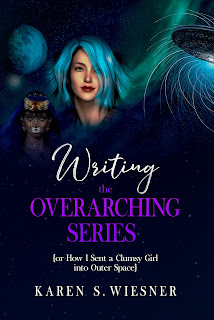
Based on Writing the Overarching Series (or How I Sent a Clumsy Girl into Outer Space): 3D Fiction Fundamentals Collection by Karen S. Wiesner (release date TBA)

https://karenwiesner.weebly.com/writing-reference-titles.html

http://www.writers-exchange.com/3d-fiction-fundamentals-series/

Karen Wiesner is an award-winning, multi-genre author of over 140 titles and 16 series, including the romantic science fiction series, ARROW OF TIME CHRONICLES

https://www.writers-exchange.com/arrow-of-time-chronicles/

https://karenwiesner.weebly.com/arrow-of-time-chronicles.html

http://www.facebook.com/KarenWiesnerAuthor

Friday, July 29, 2022

Karen S. Wiesner: SURPRISES IN THE COURSE OF LEARNING TO WRITE A SCIENCE FICTION SERIES (14 of 15)


Of Rewards Earned

This is the fourteenth of fifteen posts dealing with surprising things I learned in the course of writing a science fiction series.

Thus far throughout this 15-part article series, we've looked at a lot of what could be considered the hurdles that have to be leapt over in order to write an Overarching science fiction series. But there were a lot of amazing things that came with the endeavor as well. Let's talk about a few of the wonderful perks earned in the process of writing an Overarching Series in a few random musings.

Showing Off Your Baby

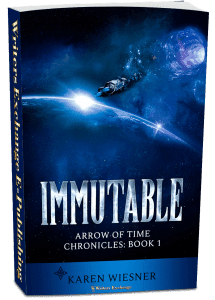
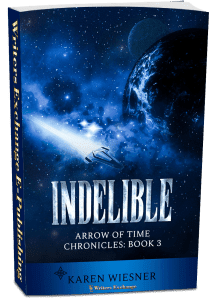
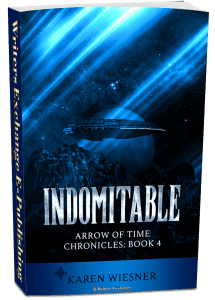
Cover art can be the icing on the Overarching Series cake. It's my opinion that the cover designs in the speculative fiction genre can be some of the most eye-catching of any category of fiction…or they can be simply generic, which really sucks and, hey, talk about a missed opportunity! I started designing my own covers for my sci-fi series during the early part of researching the series, and, as my series evolved, I continued looking for just the right cover graphics that truly fit the series and stories contained in each book. I wanted to be able to look at the covers and forever remember the events, thereby immortalizing them in my mind. I also wanted readers to take one look at them and think, Wow, how cool. I gotta read this. Later, just before my series went to the publisher for editing, a professional cover artist finalized my initial designs into the oeuvre d'art you'll see below. I've lost track of how often readers tell me how striking the covers are. 


 The ship on the cover of the first book is my beloved Aero, the Human Corvette cruiser, coming out of a space corridor.


 The graphic on Book 2 is the Vreah battleship, Vashtii, which, despite being a slow, massive, heavily-armored stealth warship also resembles a luxury "cruise" ship in space.


 Book 3 not only shows the light and fast Quing ambassadorial ship Vlacos but you can see that the "black maw" (the dark energy menace in the series) has eaten part of a planet, possibly their own planet Qu or Gurgh.


 Finally, the last cover shows the secret military base Neth-Beo, militarized by the warring Sinshe-Shojani, along with their most deadly dreadnought, Paladin. Behind it is the weapon of mass destruction they've been building, which is also a stealth ship.


While personalizing your cover designs makes them super cool, breathtaking and memorable, there's another reason for going the extra mile with them. Covers this gorgeous can't help but get noticed by the buying population. Additionally, having similar cover designs for each book is a huge help in creating instant recognition for that series and a series logo should also be a priority. (The four-pointed arrow at the bottom to the left of my name is the series logo for Arrow of Time Chronicles. It also served as the series break graphic on the interior.) Looking at the Arrow of Time Chronicles covers above, you can tell they're all part of the same series, can't you? Yet they're all distinctive separately as well. We talked about series branding in Chapter Four, and cover art is definitely part of that, especially for an Overarching Series.

Be proactively creative in even these "outer" aspects in bringing a series to life as well as offering it proudly and lovingly to your readers. Showing off the cover art is definitely one of the most rewarding perks I've found in writing a series like this.

Baby's Got Back…matter

One of the things I love most about the speculative fiction umbrella is all the lore associated with these genres. As a reader, I can't get enough of this stuff and I always buy the books associated with series covering the lore. If I can get that in the back of the books themselves, that's an even better bonus.

In my science fiction series, this meant I finally got something I've always wanted to be a requirement for my books: Back matter! While the word "back matter" can have many definitions, the one I'm talking about here is the sections in the back of the book that provide further reading, deeper explanations, and a whole host of interesting information about aspects of the series. I love reading this kind of thing in any series, whether it's a book, movie, or videogame. I want to know more. In fact, I want to know everything!

In the case of Arrow of Time Chronicles, I had a specific reason for including back matter in each installment of the series that, unfortunately, really had nothing to do with It's just so cool! Because there were so many characters, locations, historically significant events, and distinctive cultures in my series, along with unique Standard Operative Procedures, I included three appendices: 1) a Human timeline/history, 2) brief culture and homeworld specifics, and 3) a dictionary of terms. These were placed in the back of each book in the series. Even the longest one in Book 4 was little more than 30 total pages. I didn't want to significantly add to the page length of any of the books, since most of them were pretty large anyway, close to 100,000 words. The biggest reason the back matter was necessary, was because I didn't want to repeat large chunks of crucial information from one book to the next that could have overwhelmed any of the chapters in the story in a hurry. Instead, I included the important information that readers might have forgotten from one book to the next or simply needed a refresher on in a place that wouldn't overload the text. That freed me up to get on with the storytelling. 

Rejoice when you get to cross a few cool things off your bucket list with the rewards earned.

Next week, we'll conclude this article series covering the surprises I had in learning to write a sci-fi series. 

Happy writing!


Based on Writing the Overarching Series (or How I Sent a Clumsy Girl into Outer Space): 3D Fiction Fundamentals Collection by Karen S. Wiesner (release date TBA)

https://karenwiesner.weebly.com/writing-reference-titles.html

http://www.writers-exchange.com/3d-fiction-fundamentals-series/

Karen Wiesner is an award-winning, multi-genre author of over 140 titles and 16 series, including the romantic science fiction series, ARROW OF TIME CHRONICLES

https://www.writers-exchange.com/arrow-of-time-chronicles/

https://karenwiesner.weebly.com/arrow-of-time-chronicles.html

http://www.facebook.com/KarenWiesnerAuthor

Friday, July 22, 2022

Karen S. Wiesner: SURPRISES IN THE COURSE OF LEARNING TO WRITE A SCIENCE FICTION SERIES (13 of 15)

Of Reader Reactions and Lessons Learned

This is the thirteenth of fifteen posts dealing with surprising things I learned in the course of writing a science fiction series.

Learning to write a complicated Overarching Series brought with it hard lessons I didn't expect to have to learn like reader expectations not being what I hoped for and getting back up after getting iffy reviews or criticism. When the dust settled after the fallout, I also discovered there are unexpected rewards that might make up for any disappointments. We'll talk about the good, the bad, and the ugly you might have to face while writing an Overarching Series in this chapter. 

When I went into writing my first Overarching Series, I had a lot lofty aspirations and weird ideas about producing something so groundbreaking, so electrifying and life-changing, it would be talked about in hushed whispers even after I was dead... Yeah, okay, so maybe that was stupid. I was and still am a novice in this genre and with this type of series in general, but I will admit that, even though I've now got two very complex Overarching Series under my belt, I still go into these particular projects with the hope of coming out with an authentic magnum opus.

Underneath the silliness, I did actually go into Arrow of Time Chronicles with a few unwavering intentions. I deliberately didn't want the series to answer all the questions it posed. The first thing I wanted to embed within the series arc was the unspoken commentary that nothing ever really changes and sentient beings rarely reach a pinnacle of peace and solidarity, regardless of how advanced they might become. Even if you leap forward into the future, most things still work the same way (especially the way so-called intelligent entities fight about every little thing and politics rules every community, whether certain members of it want it to or not). I had a scene in Book 3 where representatives of all the cultures from all around the galaxy are in the same room arguing about the best way to handle a situational conflict that faces them all. That heated conversation was viewed with confusion and surprise from the perspective of a young, mischievous girl, her differently-abled friend, and their unique pets while in a well-chosen hiding place. It's one of my favorite scenes in the entire series for its humorous narration on timeless sociology mores. Did readers get what I was going for with these vows? I doubt it. But it was important to me anyway.

Related to the previous unspoken commentary in the series arc was the second series question I wanted to remain ambiguous. From the start of the series, I knew I wanted to instill the sense that the threat of war is always on the horizon, that wars never truly end, and, when a new threat ultimately presents itself, we'll always realize that it was actually there all along, something left over from the previous war, waiting to resurrect and implode. However, after the series was published, one reviewer commented that, "This novel concludes the series, but a large, threatening thread is left dangling."

We've had in-depth discussions about cliffhanger endings in this manual, but what this reviewer was referring to wasn't a cliffhanger in any sense of the word. My story and series arcs were all resolved completely. She was referring, more accurately, to what I call a "possible reemergence ending". Basically, in the final scene, the conflict or opposition reemerges, implying that at some point the bad thing that happened in your story/series will happen again in the future. Just when you thought it was safe to go back in the water… Readers tend to love or hate these kinds of endings, but if a possible reemergence ending fits, each author has to decide whether or not to take the risk and use it.

In my case, I admit I waffled about including that reemergence epilogue for a long time while I was outlining and then writing the draft of the final book in the series. I finally did decide to go with it because I didn't break the implicit compact that's built into the offering of any book to a reader, which is to satisfactorily tie up every loose end--series and series arcs. I also didn't give anyone a "lady and the tiger" ending, which I passionately hate myself. A little more about that:

Frank R. Stockton's book, The Lady and the Tiger, in which he leaves it up to the reader to decide which came out of the door--the lady or the tiger--is the inspiration behind what writers dub a "Lady and the Tiger" ending. While some love this kind of ending, few would call this type of resolution anything but a cop-out. All loose ends must be tied up adequately in your story and this kind of ending denies that, refuses it, kicks the reader in the face. I personally believe these kinds of unfinished stories are written for the sole purpose of making the author and/or select readers feel superior about knowing something other, lesser minds don't and can't grasp.

Not providing satisfactory resolutions violates the contract between the writer and the reader, forcing him to do without an effective tie-up of some or all story threads. I also suspect some authors do this because they simply want to leave the resolution of the series arc mysterious and unanswered. They either don't have a good enough resolution planned, or they want to encapsulate the mystery indefinitely. For an example, we never did get a straight answer about what really happened to Mulder's sister in X-Files, not in nine seasons and a couple movies (nor did I get the definitive answer in the miniseries that aired in January 2016).

If the author is never going to answer a nagging question, why invest anything, especially time and passion, in the story? Leaving a story thread dangling isn’t something an author can do without making readers furious, perhaps enough to ban your books for life. They’ll feel cheated, and rightly so. Don’t underestimate the damage a vengeful reader can do to your career. (Have you read Stephen King’s Dolores Claiborne?) Seriously, to write a story is to promise the closure and/or resolution of unanswered questions. Authors should never cheat their readers, bowing out before actually finishing and avoiding the provision of an ending complete with answers to all burning questions.

In any case, it bothered me tremendously that the reviewer left my series feeling the way she did, although I knew when I added the reemergence ending that it was a risk. I pointed out to her the truth about what kind of an ending this was, and she did agree I didn't actually leave any of the story threads dangling. Nevertheless, she didn't revise the review she put up everywhere. So I have to live with that and some readers might be turned away from the series unfairly as a result. Sucks, but there's very little I can do other than see the bright side that, luckily, other reviewers put a positive spin on the potential reemergence by saying the ending gave them goosebumps and startled them with new possibilities.

Being misunderstood can and does happen, especially to writers. As I mentioned in the Introduction, I told my husband and son one fateful day of wanting to write something like Star Trek (a series I love in all its many iterations) with a Clumsy Girl on board the spaceship. In truth, I didn't really want to write another Star Trek wannabe. I went out of my way to avoid having Arrow of Time Chronicles end up like any other science fiction saga that was popular. I wrote me, which by definition is probably different than almost everyone and everything else.

One of my first readers of the series had little experience with the genre. Star Trek was actually the only sci-fi program this reader I'll call Bob had ever seen and he hadn't read any other books in that category. Because he was expecting the same premise and story he would get from that sci-fi program, I think there was ultimately no way for him to find a way to like my series, which actually made him a great critique partner because he saw things from a perspective I didn't get from any of my other critique partners. I highly recommend that all writers try to get a first reader or critique partner who doesn't read in their genre by choice just to allow the work to be viewed from every conceivable perspective. As much as I initially hoped to bring Bob onboard and make him a believer, he'll probably never delve any further into this genre in large part because he just didn't get what I was trying to do with mine, even if he found my attempt well-written. Oh, well. Apologies and gratitude, nevertheless, Bob. No hard feelings.

I considered adding a subtitle to this section of the chapter along the lines of "What Else Can You Do with Bad Press?" At this time, all the reviews I've received for my sci-fi series have been between 4 and 5 star ones. However, the lowest ranking review (which still rated 4 very impressive stars) that bothered me most taught me probably more about writing in this this genre than anything else. But, dang, if it didn't hurt more than any other review I've ever gotten in more than two decades of being a published author. Woven in with great comments about the final book in the series, loving and worrying about the happily-ever-after of the characters, fascination with the suspense events that unfolded and resolved satisfactorily, and looking forward to more from an "amazing author", I received a comment that bit the big one. The tactful way to say it is that the reviewer felt the showdown was rushed.

Sigh! Science fiction, like most other thrilling genres, is supposed to be packed full of action and adventure, thrills and spills, awws and oohs. I felt I met that criteria in spades throughout the series, but final battles are hard to write and I doubt too many authors would tell you otherwise, regardless of their popularity or skill. As a writer, you do your darndest to provide readers with lots of hairpin twists and turns, emotional exhilaration and suspense along with nail-biting, whipsawing action. And, as an author, you'll doubt yourself every step of the way, too. Maybe I didn't add enough complications or drama, maybe I didn't raise the stakes and withhold the prize long enough. I've learned to always question my showdowns, always layering the clash with multiple tiers of heightened tension and potential for failures, throwing more obstacles than I'm comfortable with in the way of steady progress toward the story goal, and withholding the ultimate achievement of success until the reader feels like he could collapse on the floor, little more than sweaty pulp, from the tenterhooks of anxiety he's been hoisted up on. I've learned not to be content with stimulating tour-de-force but to take it up a further notch to heady blood-rush. And, maybe most importantly, I've learned to be grateful for positive reviews and not to dwell too much on the negative.

Learning to use the good, the bad, and the ugly reviews not just to take center stage on your dartboard is a skill--a grace, if you will. Accept that you can't please everybody and that not everyone will understand what you're trying to do. But, at least in my case, I still found that the outcome of my efforts were worth every bit of the sweat, blood, and tears I poured into it because I could always remind myself of the burning purpose I felt when I first wrote my series.

It's never easy to pour your heart and soul into something only to have the public throw rotten tomatoes at it. Remember the  purpose that compelled you to write the series in the first place. Learn to take the good from the bad. 

Next week, we'll take on the wonders of writing in this genre in a slew of random musings.

Happy writing!


Based on Writing the Overarching Series (or How I Sent a Clumsy Girl into Outer Space): 3D Fiction Fundamentals Collection by Karen S. Wiesner (release date TBA)

https://karenwiesner.weebly.com/writing-reference-titles.html

http://www.writers-exchange.com/3d-fiction-fundamentals-series/

Karen Wiesner is an award-winning, multi-genre author of over 140 titles and 16 series, including the romantic science fiction series, ARROW OF TIME CHRONICLES

https://www.writers-exchange.com/arrow-of-time-chronicles/

https://karenwiesner.weebly.com/arrow-of-time-chronicles.html

http://www.facebook.com/KarenWiesnerAuthor