Showing posts sorted by relevance for query Karen Wiesner. Sort by date Show all posts

Friday, October 03, 2025

Summer and Autumn Sampler by Karen Wiesner


Summer and Autumn Sampler

by Karen Wiesner 

Happy Fall! In honor of another summer gone past and the beautiful Fall leaves, I'm posting some of the newest, nature artwork I've been doing with initial pencil sketches followed by my colored pencil versions of them. 

Note, all of these are copyrighted by the artist (Karen Wiesner), illegal to download and distribute, and not available for reproduction or use for any purposes. 

Calla Lily Sketch @by Karen Wiesner

Calla Lily Rendered in Colored Pencils @by Karen Wiesner


Rosebud Sketch @by Karen Wiesner


Rosebud Rendered in Colored Pencils @by Karen Wiesner 


Fall Leaves Sketch @by Karen Wiesner


Autumn Sampler Rendered in Colored Pencil @by Karen Wiesner


Be sure to check out my website and the blog there to remain in the loop of all I'm doing: https://karenwiesner.weebly.com/. 

Karen Wiesner is an award-winning, multi-genre author of over 150 titles and 16 series.

Visit her website here: https://karenwiesner.weebly.com/

and https://karenwiesner.weebly.com/karens-quill-blog

Visit her publisher here: https://www.writers-exchange.com/Karen-Wiesner/ 


Friday, August 21, 2026

{Put This One on Your TBR List} Review of Wolf Worm by T. Kingfisher Paired With Karen Wiesner's Botanical Artwork by Karen S. Wiesner


{Put This One on Your TBR List}

Review of Wolf Worm by T. Kingfisher

Paired With Karen Wiesner's Botanical Artwork

by Karen S. Wiesner 

  Beware: May contain unintended spoilers! 

T. Kingfisher (the pen name of Ursula Vernon) is a versatile author, illustrator, and artist. Her novel Wolf Worm, published in March 2026, is exactly the kind of gothic fiction I love--you know, without the needy, pretty--according to her own assessment--damsel in distress who gets sucked into a life-threatening situation that seems supernatural on the surface (but, like every episode of Scooby Doo, isn't). Oh, and she makes everything worse with her stupidly romantic nature and need to be rescued by a big, strong man. 

A little background about this tangent I'm going off on: A few months ago, I was looking for a new audiobook to get interested in and stumbled across the 1966-1972 Dark Shadows book series, credited to Marilyn Ross (one pseudonym of W. E. D. Ross, an actor, playwright, and author of more than three-hundred novels!). The thirty-three books in this series were gothic romances (that dealt with an actual vampire and other monsters), but not what I consider particularly good ones. In any case, the first volume, Dark Shadows, was flat-out painful to listen to. This obviously male author didn't understand the first thing about women, and it showed. I can't tell you how many times we were given a physical description of the female lead somewhere along these slightly exaggerated lines: "Victoria brushed aside her thick, luscious locks of perfectly-coiffed hair surrounding her hauntingly beautiful, heart-shaped face." Give me a break. Every man in the vicinity was attracted to this goddess, but she had eyes only for the psycho-villain-or-dashing-hero? widower of the piece. Nothing could convince her to save herself. Alas, this was just the tip of the iceberg on the type the gothic fiction I despise. 

In subtle contrast, the basic formula of a really good gothic romance is a strong, smart woman (who's probably passably attractive but the reader isn't beat over the head with descriptions of her world-stopping, leave-no-male-unaffected beauty) who finds herself in unfortunate circumstances. She's forced to go to an isolated property where something sinister is going on and usually has been for decades. While she might ultimately fall in love with the main suspect, the romance is secondary to the creepy setting and mysterious events that have usually been unsolved and that she has to investigate and resolve before dire harm comes to her. This is a worthy heroine who saves not only herself but the others around her as well as the day. 

That's exactly what T. Kingfisher has brilliantly given us in Wolf Worm, set in 1899. Sonia Wilson is a thirtysomething botanical illustrator. Kingfisher is herself an extremely talented artist, and, given my own love of rendering plants in art form, I just soaked up everything creative she offered in this tale. The easy knowledge of the author made her main character so authentic and compelling. Sonia's father was a renowned scientist, something she aspires to, but, after he died, she was left to make her own living in whatever way she could, as most orphaned "spinsters" were forced to in that time period. Eventually, she's offered the job of illustrating Dr. Halder's insect collection on his reclusive manor property in the woods of North Carolina. Other characters are the lovable housekeeper, Rose, and her significant other, Jackson, who also works on the estate. The preacher also inserts himself into Sonia's life after her arrival. A local healer called "Ma" something also helps Sonia when oddball things begin to happen. 

Woodland animals are acting very strangely, doing impossible things that normal animals just can't do, the household chicken coop is being robbed every night, and Dr. Halder is sneaking around in the forest after dark. There are local whispers of "blood thieves" compounded by the unsolved mystery of Halder's wife's fate. She'd cheated on him, and Halder supposedly dispatched the homewrecker--justifiably, according to some members of the local population, who "don't brook with no infidelity". The real horror in this story is Dr. Halder's life's work--parasitic maggots that burrow into human flesh. I'm not a person who likes even thinking about things like this. My whole body revolts and feels like it's been invaded by horrible things that I can't even see. Long, hot, rubbed-raw showers ensue and endless hours are wasted on feeling like I'm going insane with the itching dread. (Let's face it, it's scientific fact that we do have things crawling all over us that we'd prefer not to consider let alone believe are there.) Ugh! Don't think about it. Do not start thinking about it. Whatever you do, donotthinkaboutthisplease! 

Yeah, so Kingfisher forces us to not only think about it but to watch the horror happening in Wolf Worm in slow motion. 

I have to admit, more than once, I had to go back to the audiobook I was listening to of Wolf Worm and make sure it was, in fact, T. Kingfisher, not Caitlin Starling, who'd written this. Everything about this book reminded me of Starling's work, especially The Death of Jane Lawrence (highly recommended--do a search for my review of it on this blog). Starling loves body horror fiction with strong heroines that are also slightly vulnerable, a lot broken, and far too willing to go where no sane woman might. I loved the atmosphere, the creepiness, the compelling secondary characters that really rounded out this story and made it something I couldn't stop listening to in the course of just a couple days. 

I will also add that I really would have preferred to read the book version of Wolf Worm (hard copy, though ebook would have been okay, too), but, as I'd asked to be notified of the release of any version of this book on my library app, I was glad to practically be the first in line when it became available. I liked the way the narrator made the voices fit the locale the story is set in. I do want to read a copy of the book at some point, though, because I've definitely noticed that I miss a lot with an audiobook versus reading the book myself. I'd also like to own the hard cover of Wolf Worm. It's absolutely worthy to join my collection of other T. Kingfisher print editions. 

In summary, run, don't walk, to get a copy of this book as soon as possible. If this is your kind of gothic fiction, you won't regret it. 

And, just because, here's a couple of my own fledgling botanical illustrations, both with and without color, which I'm certain are nowhere near as wonderful as anything Sonia and/or Kingfisher would produce. Looking at them again puts me in mind of the coming spring and summer growing season and the plants I'm hoping to photograph, sketch, and/or color this year. 

Rosebud in Vase Sketch @ Karen Wiesner  Rosebud in Vase Sketch @ Karen Wiesner 

Leaf & Twig Texture in Colored Pencil @ Karen Wiesner  Leaf & Twig Texture in Colored Pencil @ Karen Wiesner

Scarlet Poppies and Summer Berries in Colored Pencil @ Karen Wiesner  Scarlet Poppies and Summer Berries in Colored Pencil @ Karen Wiesner 

Karen Wiesner is an award-winning, multi-genre author of 156 titles and 16 series. 

Visit Karen here: https://www.writers-exchange.com/Karen-Wiesner/

Friday, August 25, 2023

Stop and Smell the Roses by Karen Wiesner


Stop and Smell the Roses

by Karen Wiesner

A memorial for a dear friend who passed away recently, including some of my colored pencil flower artwork.

A dear friend of mine passed away recently. I'd known her for over 20 years, and our children grew up together. They remain best friends to this day, even as she remained mine up until the end. Throughout the years I knew her, she endured multiple health issues. For the last year or so of her life, she was made aware by her doctors that her time in this world was short. When I look back now, I realize that I don't remember ever hearing her complain. I'm also struck by the fact that she didn't live like a person who was dying. She lived her life. Period. Impending death wasn't an obstacle to joy for her. She got through the bad periods, and she enjoyed the good ones. She took everything as it came. Even in her final days, she focused on what was important to her, the things that truly mattered: her husband, children, grandchildren, friends, and making the most of every moment, finding pleasure in those simple things, and never failing to let those around her know how grateful she was for their presence.

I understand the meaning of the phrase "Stop and smell the roses" (something my dear friend loved) because of her example. When an oncoming collision is headed straight for you, it's easier to close your eyes and shut down, shut off, hide inside yourself. It's impossible to enjoy life when you're concentrating on the advancing doom. So she did the best thing she could have done in the face of the inevitable: Although it was always there and she never forgot it, she found a way to turn away from it and focused instead on the roses blooming in the garden of her life. This is a lesson I hope I never forget, no matter how close I come to life's unavoidable finish line. My desire is to emulate such a beautiful standard. In honor of someone I'll miss, VJW, 8/13/23, here are some of my own floral creations.


@Rose colored pencil by Karen Wiesner

@Hibiscus colored pencil by Karen Wiesner

@Scarlet hibiscus colored pencil by Karen Wiesner

Karen Wiesner is an award-winning, multi-genre author of over 150 titles and 16 series.

Visit her website here: https://karenwiesner.weebly.com/

and https://karenwiesner.weebly.com/karens-quill-blog

Find out more about her books and see her art here: http://www.facebook.com/KarenWiesnerAuthor

Visit her publisher here: https://www.writers-exchange.com/Karen-Wiesner/

Friday, October 23, 2026

{Put This One on Your TBR List}: Review of A Botanical Daughter by Noah Medlock Accompanied by Karen Wiesner's Original Artwork by Karen S. Wiesner


{Put This One on Your TBR List}:

Review of A Botanical Daughter by Noah Medlock

Accompanied by Karen Wiesner's Original Artwork

by Karen S. Wiesner 

  Beware spoilers! 

I was looking for something to read on my Libby library app, and A Botanical Daughter by Noah Medlock came up, no doubt because of my newfound love of gardening and horror literature. This 2024 Victorian gothic chiller was the author's first book. The basic story is two Victorian-age, quirky gentlemen live a cloistered existence in an equally eccentric botanical garden. Simon is a taxidermist who views his usually whimsical (i.e., not disturbing) craft as art. Gregor is a celebrated, though somewhat spurned, horticulturist whose greatest love is cultivating wildly exotic plants. His latest acquisition is a strange fungus he's convinced is capable of unprecedented intelligence. He's determined to make it his masterpiece. Throw in a spirited housemaid named Jennifer who's a bit of an oddity herself in the community they live, and readers are treated to a whole menagerie of curiosities to explore. Jennifer has recently lost the friend she loves, one she believes was murdered by her own father, though she has no way to prove it. 

This story began in a wonderfully witty, charming way that captured me instantly, especially when the story turned into a gardener's version of Frankenstein. Seriously, what more could you want? I was mesmerized with the wonderful characters and their irresistible setting. Jennifer was unexpectedly vibrant, not willing to be defined by those around her, and fiercely true to herself and her values. Simon and Gregor were at first alike only in that both displayed erratic artist temperaments, yet the author made them very unique…at least initially. 

The first half of this book was amazing. I enjoyed every word, all the unorthodox developments, the author's clever turns of phrase that had me laughing out loud from one page to the next. I wanted to include at least one or two of the best of those gems here but my library app took the ebook back too quickly. 

Despite such a winning start, the last half of the story, regrettably, became a confounding garble of twisted, choking inconsistencies that eventually threatened to wreck the foundation altogether. It got to the point where I couldn't tell which character was Gregor and which was Simon. They became as the same person and unrecognizable from their formerly established characters. I lost track of the story because the main characters abruptly were so muddied and odiously unlikable. It was as if the author himself forgot who was who in his literary madness. Not only did the story turn to something painfully unreadable but the situations the couple's bad choices entangled them in resembled an abyss that got deeper, darker, and far less amusing than I could tolerate. The characters committed horrible atrocities that were presented in a way that ultimately condoned their behavior. Similar to another "holobiont"* set of books I recently read and was faintly appalled by**, the degeneration of values and lack of respect for life (human and plant alike) depicted at the end of this story all but crumbled to incomprehensibility, leaving me cold and filled with regrets for what could have been a brilliant first novel. The initial half was so enjoyable and fun. While I wouldn't have called this outright horror, it had moments of dread that I relished in context with all the plant concepts. I'm not entirely certain if it was an inexperienced author that was to blame for the crimes committed in the writing of the second portion of this tome, or an editor who let far too many mistakes creep in that went unrevised--probably both of these in combination. A third alternative is that this is simply the unimaginable (to me), new way books are written, and I'm just too old to appreciate it. Sigh. 

*Various symbiotic organisms joined as an ecological unit--read more about this on Wikipedia if you're interested. 

**The Southern Reach Series by Jeff VanderMeer. 

Despite my regrets for what might have been, I must say, what a lovely cover. I adore it!  Bravo, Julia Lloyd! 

To go along with the theme of this review, here's a botanical art project I recently finished for my daughter's birthday.

"Autumn…Where Nature and Imagination Merge"

(rendered in coloring pencil)

© Karen Wiesner (all rights reserved)

"Autumn...Where Nature and Imagination Merge" (rendered in coloring pencil) @Karen Wiesner (all rights reserved)

 Karen Wiesner is an award-winning, multi-genre author of 156 titles and 16 series. 

Visit Karen here: https://www.writers-exchange.com/Karen-Wiesner/


Friday, May 19, 2023

Reflections of Life, Part 4 by Karen Wiesner


Reflections of Life, Part 4

by Karen S. Wiesner

In looking back over the course of my life as an author who's looking forward to becoming an artist in retirement, I've learned to slow down and reflect on the past, savor the present, and look forward to the future. Interspersed through these ruminations, I'll include some of my own most apropos sketches.

In Part 3, I went over what brought about the strong sense that I needed to slow down as well as a few of the initial strategies I implemented in my struggle for balance in my life. After I decided a critique partner was crucial for me, ticks were made in my progress toward what I could accomplish in my remaining time writing. I was now able to return to my "To Be" list. I began to realize I needed to rename it my "To Be or Not To Be" projects. This time, I took off the list the books I didn't feel I had enough material to complete, nor did I believe I could brainstorm and bring about more, certainly not enough to bother undertaking them. Thus, the graveyard of books I was burying expanded. I grieved. I slowly and surely worked on my final two series to complete, one book at a time (for the most part anyway).

Oddly, in this process, I was also beginning to heal. I saw my editor/publisher and author relationship improving. Mutual compromise and finding a new way to accommodate my editor's suggestions, picking my battles with her, went far, but I also needed to humble myself in ways I never would have attempted in the past. I would have jumped ship and struck out anew instead.


Copyright Karen Wiesner
Karen Wiesner Sketch: Braided

The quality of my new work also surprised me. I began to feel my books were even stronger than they were in my heyday, though as I said, my editorial skills feel like they're in decline due to aging…or other reasons I'm not entirely sure I want to define.

At this point, just how very tired I'm becoming was brought home to me. All those years of balancing a hundred different projects at the same time over the course of a year had taken their toll. Inconceivable to me in the past, when I actually thought about what I would write on my death bed, I could now see a point in time when I would retire from writing…when I would do something else instead of writing. Even I'm stunned that all of this was actually cathartic for me. It needed to happen, and not just for my own well-being. I actually began to want it to happen, which wasn't something that "sat easy" with my family and friends, who seemed to see this as a kind of death sentence for me instead of the new life I viewed it as.

One last time, I went back over my "To Be or Not To Be" project list and buried a few more stories that I knew I didn't have it in me to finish. I had only two more series to finish, and even less requirements to resolve them, considering that a few of the titles in them both were cropped. As a concession to what could have been some great tales in their own right, I started incorporating some of the ideas from those lost stories into the remaining books in the series. 

Next week, I'll cover the progress I've made in restructuring my life to bring better balance.

Karen Wiesner is an award-winning, multi-genre author of over 150 titles and 16 series.

Visit her website here: https://karenwiesner.weebly.com/

and https://karenwiesner.weebly.com/karens-quill-blog

Find out more about her books and see her art here: http://www.facebook.com/KarenWiesnerAuthor

Visit her publisher here: https://www.writers-exchange.com/Karen-Wiesner/ 


Friday, November 12, 2021

Karen Wiesner: I Have Dreamed a Little Dream (Authors and Dream Inspiration), Part 1


I Have Dreamed a Little Dream, Part 1

by Karen Wiesner

"Believe in your dreams. They were given to you for a reason."

~Katrina Mayer 

As a writer, the question I get most often is where my ideas come from a lot. While I can honestly say everywhere, more often than not, dreams play a huge role of my fiction writing. Something about that twilight between sleep and dreams is a veritable playground for imagination! Bloodmoon Cove Spirits Series is one of my series, in particular, in which many of the stories within it stemmed from a fragment of a dream that I was able to develop into a story. In the course of the next several posts, I'll be going over how these these nightmarish gifts from the ether came to me. 

This will be the first of four posts focusing on my Bloodmoon Cove Spirits Series and the vivid nightmares or ideas that inspired the titles. 

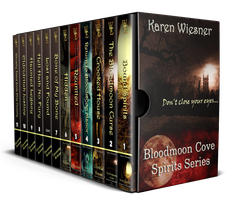
Karen Wiesner's Bloodmoon Cove Spirits Series

** Nestled on Lake Superior in northern Wisconsin is a small, secluded town called Bloodmoon Cove with volatile weather, suspicious folk…and newly awakened ghosts. 

Don’t close your eyes… **

While writing up the proposal for BOUND SPIRITS, which became the first book in my Bloodmoon Cove Spirits Series, I had an idea about writing a series of ghost stories. I love scary, terrifying ghost/spirits stories as well as fun or playful ghost ones, but I also like the idea of exploring well beyond the boundaries of what a typical ghost story is considered to encompass. I intend to delve into the depths of supernatural elements with haunted places, cursed objects, portals to other worlds and/or time periods, and even unfathomable creatures from those other realms that have crossed into ours on Bloodmoon Mountain.

At the time I was working on this spark of a series concept, I was also strongly considering pulling a standalone novel I've written, THE BLOODMOON CURSE, from its publisher at time, as it'd been lagging there for quite some time. THE BLOODMOON CURSE was very mildly a ghost story, so it certainly fit the theme. Also, the book featured a small (fictional) town called Bloodmoon Cove, and I thought that would be the perfect setting for an otherworldly series. The Bloodmoon Cove Spirits Series was born.

In late 2013, I got the rights back to THE BLOODMOON CURSE. I'd already finished BOUND SPIRTS long before that time and didn't want to wait around for it to be published, so I decided to make BOUND SPIRITS the first book in this new series. THE BLOODMOON CURSE became the second.

The (fictional) county the Bloodmoon Cove Spirits Series is set is Erie County--what I think is a clever play on Lake Erie, which is one of the nearby Great Lakes (named for a Native American tribe in the area), and also because the town and those surrounding it (including the fiction city of Grimoire that's been featured often in the series) are “eerie”.


Have you ever dreamed something that became the basis of a story? Leave a comment to tell me about it!

Find out more about Bloodmoon Cove Spirits Series here:

https://www.writers-exchange.com/bloodmoon-cove-spirits-series/

https://www.amazon.com/dp/B08MLBJ7XP

Happy reading!

Karen Wiesner is an award-winning, multi-genre author of over 140 titles and 16 series. Visit her here:

https://karenwiesner.weebly.com/

http://www.facebook.com/KarenWiesnerAuthor

https://www.goodreads.com/karenwiesner

http://www.writers-exchange.com/Karen-Wiesner/ 

http://www.writers-exchange.com/blog/ 

https://www.amazon.com/author/karenwiesner

Friday, May 26, 2023

Reflections of Life, Part 5 by Karen S. Wiesner


Reflections of Life, Part 5

by Karen S. Wiesner

In looking back over the course of my life as an author who's looking forward to becoming an artist in retirement, I've learned to slow down and reflect on the past, savor the present, and look forward to the future. Interspersed through these ruminations, I'll include some of my own most apropos sketches.

In Part 4, I covered strategies I implemented to restructure my life to bring better balance. As of this writing (April 20, 2023), I can see the end of the road before me. At my current rate of output, it's conceivable that I can finish the last three books in my last two series within the next year. In learning each day to reflect on where I'm going and what it took to get me there, I can also see just how far I've come in learning and relearning how I approach life, how I complete tasks, and accomplish the things I want to do in my time remaining. Instead of starting each morning (after the obligatory shower and coffee that have always been my initial protocol) by jumping headfirst into a mile-long list of the constant and relentless daily checklist of projects awaiting me, I now have--even by ordinary human standards--a manageable amount of tasks to complete each day.

When I avoid crash and burn habits by starting each day with study, prayer, and reflection, I actually sleep better most nights as a result. This feat isn't something I could have handled in the past, when I carted around a semi-trailer sized head full of tasks that needed nose to the grindstone diligence in order to check off each day. The thought of leisurely getting to work after beginning a day with contemplative endeavors would have been pure torture for me back when I believed I needed to fill the limited number of hours I was given each day with ACCOMPLISHMENTS.

I won't lie to you. I have backslidden. I struggle whenever I see my daily "To Do" lists grow. Amidst embarrassment, amusement, frustration, bewilderment, and even shock that I didn't see it as it was happening, I'm directed and redirected and prodded gently back to the path where I can slow down, start each day off right with morning reflection that sets the tone for the day I have, and decides whether or not I sleep well.


The part that astonishes me almost more than any other about all this is that I've discovered I actually accomplish more these laidback days than when I'm scrambling to check things off my list, causing myself so much stress I lay awake most of the night with a brain that just won't shut off. Rinse and repeat in an endless, vicious, boneheaded cycle in which I'm returned by factory reset to where I started.


Copyright Karen Wiesner
Karen Wiesner Sketch: Reading in Bed


Research has shown that there’s scientific benefit involved in practicing appreciation on a day by day basis. In a study published in the Journal of Personality and Individual Differences, Rutgers University Psychology Professor Nancy Fagley Research has shown that there’s even scientific benefit involved in practicing appreciation on a day by day basis. In a study published in the Journal of Personality and Individual Differences, Rutgers University Psychology Professor Nancy Fagley suggests that people focus on and value what they have, spend time outdoors, and. "...reflect on the positive aspects of our lives, value our friends and family, relish and savor the good times...”

I've also discovered that the faster my pace in life, the busier I am, the less I find myself enjoying any part of my life. Think about that word "enjoy". It implies taking pleasure in something, experiencing appreciation and satisfaction in things, and benefitting from the act of savoring and relishing as opposed to viewing the blur of my life as it goes speeding by, leaving me coughing or even run down in its passing dust. There are also strong connotations of reverence and veneration in the word "enjoy". Daily reflection has taught me that humans can only honor and respect the countless blessings that make up our lives by allowing the whole of our beings--physical, mental, and spiritual--to slow down to enjoy them.

Karen Wiesner is an award-winning, multi-genre author of over 150 titles and 16 series.

Visit her website here: https://karenwiesner.weebly.com/

and https://karenwiesner.weebly.com/karens-quill-blog

Find out more about her books and see her art here: http://www.facebook.com/KarenWiesnerAuthor

Visit her publisher here: https://www.writers-exchange.com/Karen-Wiesner/

Friday, May 12, 2023

Reflections of Life, Part 3 by Karen S. Wiesner


Reflections of  Life, Part 3

by Karen S. Wiesner

In looking back over the course of my life as an author who's looking forward to becoming an artist in retirement, I've learned to slow down and reflect on the past, savor the present, and look forward to the future. Interspersed through these ruminations, I'll include some of my own most apropos sketches.

In Part 2, I discussed what it took to bring about change in the crash and burn lifestyle that dominated most of my adult life. On a daily basis, I began to sense the gentle nudge that led to the restructuring and reallocating of my energy and ease in juggling multiple projects at once. However, I can't move forward with this reflective essay without adding that the years of COVID hell were strong contributors to what truly seemed like the mighty falling and the dwindling effectiveness of my previously relished Super Powers. Like many other authors who struggled to produce anything salable during those aghast (in this context, an odd but fitting word) years, I produced next to nothing until at last light again penetrated the emotional void of my blackest period of existence. I saw distinct changes in my writing, from the quantity I was capable of producing right on down to the quality of the material. Some of these changes were for the better, others most certainly for the worse.

Ultimately, I came to the point where the only way to cope with my drastically altered form was to say "It is what it is", and move forward the best way I could. I had to learn to accept the new me, which most days seemed like a weaker, pitifully lessened, shell of myself. What came next was the aftermath of battles fought and lessons learned.


Copyright Karen Wiesner
Karen Wiesner Sketch: Innocence Light and Dark

I went through the projects I'd once upon a time fully anticipated completing during my lifetime and evaluated whether I would or even could complete them after all. I started with the ones I'd already faced issues with in attempting to outline. In the course of my career, I'd realized that if I could finish an outline for a story, I would be able to write the book to my satisfaction. The first step was to remove those uncertain projects from the "To Be" list. A huge chunk of wannabe books fell by the wayside in this endeavor. On the plus side, I was able to finish within the next year two of the four series I had left to complete.

I also started gathering backup against having to endure further revision nightmares. I wanted to ensure as far as I possibly could that the body of material I submitted to the publisher I intended to keep for the rest of my career was as solid and flawless as I could make it. Over the years before my crisis, I'd begun to forsake critique partners for two very distinct reasons. The first reason is practicality. Simply put, I wrote too much and too fast to ask any critique partner or even a whole team of them to do so much for me. I think a crew, each member taking on a full-time job with handling even just a few of my books at a time, would have been required through most of my career. I did have a variety of critique partners, most of the time more than one, all put on different projects, but eventually it became harder to find ones I really trusted and believed were equal to the task. (I apologize if that sounds conceited, but…yeah, being practical, that was the way things stood.)

My second reason for not having critique partners for every single project was exactly what you may have guessed from that last paragraph: I got big-headed enough to assume in those later years before my crisis that I didn't need any helping making the majority of my books better and stronger. I thought I could do it completely on my own. Live and learn, but I have now found one single reliable critique partner that I'd worked with on and off in the past. I trusted her implicitly then, and even more so now that I find my once honed and sharp editorial skills becoming a bit more lax than even I'm comfortable with. Since my output has also been diminishing rapidly in these crisis years, I hoped I wouldn't overwhelm her with critique projects. I admit I definitely would have done that if not for the fact that the pipeline of my book releases has become hopelessly clogged during this time, stopping almost altogether in the course of the last five years as my only publisher has taken to renovating her entire backlist of books with new cover designs, fresh formatting, and updated promotion.

Next week I'll go over other strategies I implemented to restructure my life to bring better balance.

Karen Wiesner is an award-winning, multi-genre author of over 150 titles and 16 series.

Visit her website here: https://karenwiesner.weebly.com/

and https://karenwiesner.weebly.com/karens-quill-blog

Find out more about her books and see her art here: http://www.facebook.com/KarenWiesnerAuthor

Visit her publisher here: https://www.writers-exchange.com/Karen-Wiesner/

Friday, May 05, 2023

Reflections of Life, Part 2 by Karen S. Wiesner


Reflections of Life, Part 2

by Karen S. Wiesner

In looking back over the course of my life as an author who's looking forward to becoming an artist in retirement, I've learned to slow down and reflect on the past, savor the present, and look forward to the future. Interspersed through these ruminations, I'll include some of my own most apropos sketches.

In Part 1 of this article, I talked about feeling directed to find a better balance in my life. One of the first things required in order to bring about very necessary changes in my crash and burn lifestyle was the crushing of my ego. I've spoken before in my writings of the worst experience I've ever had with editing a project. Specifically, when I completed my Arrow of Time Chronicles (a massive science fiction saga) over the course of two intense years, I truly felt that I'd written my pièce de résistance. I believed it was the best thing I'd ever written up to that point. I was on top of the world. I couldn't wait to have my masterpiece published and in the hands of my readers. The editing process took place over the course of several months as all four books were released back to back.

As a little background to ensure full understanding before I continue, in the span of my writing career, I've written for at least 25 different publishers big and small, at first because it was the only way to get my horde of books out to the world as quickly as possible, considering how fast I wrote. Following a few years of the worst luck possible with some of my publishers who, frankly, "did me wrong", I decided to place all my books with a single publisher, the only one at that time I actually trusted, and still do. One after the other and sometimes in huge batches, I pulled my books from my other publishers, revised and reformatted each of them, and gave them to this one publisher, who, initially, reissued the majority of them very quickly, all while also publishing my brand new works.

From my very first book published in June 1997 to the one just before Arrow of Time Chronicles, the revisions handed down to me from any of my numerous editors had been mild up to this point, amounting to a few typos needing correction or sentences that required reworking for clarity with each book. With my first two writing reference books, editors wanted me to add certain sections, which meant drafting new material to coincide with a feature they wanted to see displayed in the manuals. All told, none of this was serious. Structurally, from the start of my career, all my books were solid and polished even before I submitted them. I possessed the editorial skills to make them so.

To this day, I'm not a hundred percent sure why this particular project caused such a rift between me and my publisher (who was also my editor for all my submissions). Even after the arduous, soul-tearing editing was completed, I still believed the four books in Arrow of Time Chronicles were some of my best to date. The agony I suffered through four excruciating times with each of the books in that series decimated me in ways I couldn't have previously imagined, given my editing history. I left the process limping and bleeding each time, my spirit ground to ash. My confidence took such a violent blow, I never wanted to write again because it meant inviting further attacks that would surely come during editing. While I couldn't and wouldn't do anything as drastic as quitting writing, all the spinoff books I'd planned to write in the Arrow of Time universe, once the four-book set was published, were summarily canceled. I couldn't take the risk that this series had been the cause of the damage that wreaked havoc between me and my publisher.


Copyright Karen Wiesner
Karen Wiesner Sketch: Agony

As I said, I didn't quit writing altogether, but I did know I needed and wanted to make changes. In the span of my career, I've started 16 series, varying in length from three to twenty-three books in each. At that time, all but four of the series had been finished previous to this crisis. There was no way I could abandon those final four series without providing satisfactory resolutions. 

Over the next two years, I worked hard rebuilding my relationship with my editor, who was my only publisher now. While I can't take full blame for the problems between us, I know I did my share of harm. Chief among my issues was that my ego and (what seems like now) certainty that my every word was golden needed to be checked with humility and the willingness to compromise. These two lessons were hard fought battles for me, both internally and externally. In the process of learning them, I also undertook the heart-rending job of culling my list of upcoming projects.

Next week I'll talk about what brought about the strong sense that I needed to slow down.

Karen Wiesner is an award-winning, multi-genre author of over 150 titles and 16 series.

Visit her website here: https://karenwiesner.weebly.com/

and https://karenwiesner.weebly.com/karens-quill-blog

Find out more about her books and see her art here: http://www.facebook.com/KarenWiesnerAuthor

Visit her publisher here: https://www.writers-exchange.com/Karen-Wiesner/