Thursday, February 17, 2022

Viable Villains

I've just finished reading Dean Koontz's latest fantasy thriller, QUICKSILVER, which I like better than a lot of his recent novels. For many years, almost every book he's written has featured the same kind of villain (or a secret cabal of them)—a sociopath with delusions of grandeur, an evil genius, at least a genius in his own eyes, dismissing the rest of the human species as inferiors who, if not deserving of extermination, exist only to serve the few elite supermen. QUICKSILVER does include one of those annoyingly unrelatable, often flat-out unbelievable characters, but he appears only briefly. The other human antagonists work for a covert federal agency; their motives make sense in context, to carry out their orders and suppress the danger they believe the hero represents. The principal villains, invaders from another universe, have no humanly relatable personalities or goals, but that inhumanity is appropriate to them. They're almost Lovecraftian in their alienness.

Aside from such utterly alien creatures, however, the typical sapient antagonist (as opposed to an animal or a force of nature) should have some relatable traits in the form of motives we can comprehend even if we condemn the methods of pursuing those aims. Even many readers' favorite "pure sociopath," predatory genius Dr. Hannibal Lecter, has desires other than his cannibalistic cravings, goals we can sympathize with. He wants freedom, along with the comforts and luxuries denied him in his windowless, high-security cell, as anybody in that plight would.

Frankenstein's creature wants kindness and companionship; only rejection turns him bitter, vengeful, and violent. Count Dracula wants to leave his worn-out homeland for a new country of boundless opportunity. Dr. Jekyll begins with the noble goal of splitting the evil dimension of humanity from the good and thereby controlling the former. The Phantom of the Opera wants the admiration and devotion of a young woman. In more recent fiction, Michael in THE GODFATHER doesn't start out as a bad guy; indeed, he has deliberately tried to dissociate himself from that part of his background. He devolves into a villain when his determination to protect his family gradually entangles him in his father's criminal empire. According to an often cited principle, every villain is the hero of his or her own story.

To me, more often than not, one-dimensional evil geniuses such as Koontz's recent antagonists feel no more believable than the supervillains in an old cartoon series whose purpose was "to destroy the universe for their own gain." They're sometimes fun to read about, but I can't in the least relate to their motivations.

Margaret L. Carter

Carter's Crypt

Friday, February 11, 2022

Karen S. Wiesner: Blurbs Series, Part 6: Series Branding

 Writer's Craft Article by Karen S. Wiesner 

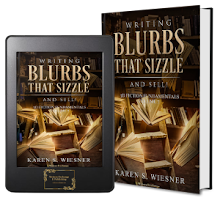
Based on Writing Blurbs that Sizzle--And Sell! by Karen S. Wiesner 

Blurbs Series, Part 6:

Series Branding

This is the last of six posts focusing on writing effective blurbs for your books. 

In the previous part, we talked about blurb sizing and branding. Let's continue.    

Series Branding 

Rule 1: Associate the Series With Each Title 

To me, this one is so out-and-out obvious, I feel a bit foolish even mentioning it. If your readers don’t know that your book is part of a series, what’s going to prompt them to look for the next one and the next one and the next one after that? It should be so blatant, yet this is the number one series rule I see broken most frequently, and it’s such a missed opportunity. Look at the website of any book distributor, and you’ll often have a hard time finding out if a book is even part of a series. A few publishers are diligent about this, but most don’t bother. 

Make sure the title of the book is always, always, always associated with the series. In other words, never allow yourself or your publisher (if you can help it) to include just the title of your book. For instance, I never refer to my book Shards of Ashley simply by its title. Always, I refer to it as Shards of Ashley, Book 5 of the Family Heirlooms Series. Notice several things about this: I include the title of the book, the book number in the series, and the series title. In this way, new readers and long-time fans immediately recognize the information they need to know.

A new trend in the industry that needs to be addressed here is that many distributor websites are becoming sticklers about how your cover and title page have to match in terms of how the title, series and book number are listed. I've had books rejected for distribution because the cover creatively has the title in one place, the series in another, and just the number in some kind of artistic "seal" elsewhere. Because the title page has the book listed as, say, Shards of Ashley, Book 5 of the Family Heirlooms Series, the book is rejected as "not matching". This is beyond ridiculous, in my opinion, since they're clearly the same, though automated systems may be too dumb to realize it and you'll have to ask that a human at the place of distribution look into it. When this inquiry has been undertaken in my case, approval is always forthcoming. But authors and publishers need to be aware this is a growing trend and adjust accordingly. 

Additionally, my publisher for Writing Blurbs That Sizzle--And Sell! (and my fiction), Writers Exchange, always lists the series name first, followed by the title and the book number in the series, as in: Family Heirlooms Series, Book 5: Shards of Ashley. Her very sound logic is that, with the series name first, all the books tend to be listed together (and almost always in the correct order) on websites that list only based on the title in alphabetical order. If you have the title of the book first, the other books in that series can end up on totally different pages, which isn't ideal.

For those readers who try to follow a series, it’s extremely helpful to include the book number in the series whenever you talk about a particular title. On the listservs I patrol, I’ve heard a huge number of series readers say they won’t skip around in a series—they start at the beginning and read chronologically. Very few readers will skip around. Having the book number associated with the title (and even on the spine and/or front and back cover, as we’ll talk about soon) ensures that readers know exactly where this book falls in the series. Make a point of being consistent in the use of the title of each book and trilogy/series name by ensure that the whole title of the book is always associated with the series.

Even in the process of working with your editor, continue stressing this point to enforce to her that you see all the stories as part of the series—one book can’t be separated from the other because they belong together. Self-publisher authors need to do that themselves. 

While publishers and self-published authors utilize distributors for getting the books out to the customers, the people in control of publishing provide all the information necessary for distributors to sell the books. Hence, those people doing the publishing tend to not provide series information at all, or only incompletely, along with the basic book information. Talk to your editor/publisher about associating the series name and book number for every single title. Self-published authors, make sure you're doing this. Make sure this information makes it to distributors consistently.

 If your publisher isn’t diligent in this regard, you can change your information at Amazon.com, BarnesandNoble.com, and other online distributors. While you’re logged in to these sites, the page for your book may have a section labeled with something like "Update This Information". Sometimes publishers won’t allow anyone to change the book information, but if you find that you can change it yourself, do so! 

Take my advice: If your publisher won’t follow through on this particular branding, rigorously follow the advice yourself. For every scrap of promotion you do for the series, make sure you include the complete series information for every title. Absolutely do this for your website. You might even consider putting a list of series on your website with the title in each series and the book number—and maybe even making this list printable. That way, your most avid followers can get the information they need without too much hassle. Remember, you can lose sales by making basic information hard to come by. 

Rule 2: Utilize Series Blurbs 

It’s necessary to utilize series blurbs as much as possible to create brand awareness for it. Don’t underestimate the appeal of the series blurb. New and longtime series readers alike want to know how the current book connects with others in that series. If the series blurb is effective, those sentences will accurately reflect the premise of every book in the series in a concise, intriguing summary. Series blurbs can sell books just as surely as story blurbs can. An author would never consider skipping a story blurb—a publisher wouldn’t either. While some publishers write and use their own series blurbs, the series blurb is often underrated and underutilized—to our detriment. 

This is the second most common series branding rule I see broken. In this case, it’s not just the publishers who neglect to utilize the series blurb. Recently, I wanted to find out more information about a certain bestselling author’s series. The series had been around for a while, and several books were already available. I went to the publisher’s website, the author’s website, and even distributor websites trying desperately to find out what the series was about. The story blurbs were fine, but they didn’t tell me enough about the connections between the individual books to really appeal to me. (Not to mention that none of the books had numbers, so I had no idea about the order of the series, so finding out where to begin would have been a headache.) When I buy a series, I look first at the series blurb, since that tells me what I’m getting into. If that entices me, I’ll read individual story blurbs (in order). If I like those, I’ll make a purchase. In this case, the information I needed was nowhere to be found. I got tired of chasing after it, and this author (my apologies if none of this was her fault) lost the sale of all of these particular series’ titles.   

I do feel bad about that, because I know authors who aren't self-published have little if any control over aspects of publication when working with mass-market (and sometimes even small press) publishers. But that particular author did have control of her own website, and she failed to give me the information I needed to make a purchase enticing, or even inevitable. 

Utilizing your series blurb is critical to branding. It is part of what convinces a consumer to begin your series. If she likes what she reads, she may buy every single book in the series. But if she doesn’t know what she’s getting into, she may never bother. If enough consumers have this attitude because the publisher and/or author make it a hassle to obtain vital information, your series will fail to gain readers. A series isn’t like a single-title book. If you lose readers from the beginning or anywhere in the middle, you’ve lost them for its entirety. Some series authors never recover from this. 

Bottom line, the only reason for shortening a blurb that's already effectively good is because we're forced to because of publishing and marketing considerations and limitations, and blurbs are an important part of the branding package of author, books and series.  

In this series of articles, we went over the most basic considerations in crafting blurbs that not only sizzle but can sell your books. 

Karen S. Wiesner is the author of Writing Blurbs That Sizzle--And Sell!

Volume 7 of the 3D Fiction Fundamentals Collection 

http://www.writers-exchange.com/3d-fiction-fundamentals-series/

https://karenwiesner.weebly.com/writing-reference-titles.html 

Happy writing! 

Karen Wiesner is an award-winning, multi-genre author of over 140 titles and 16 series. Visit her here:

https://karenwiesner.weebly.com/

https://karenwiesner.weebly.com/karens-quill-blog

http://www.facebook.com/KarenWiesnerAuthor

Thursday, February 10, 2022

Most Writers Are Writers

This is the name of a page on the TV Tropes site, referring to the countless works of fiction with authors, playwrights, screenwriters, journalists, or poets as protagonists, a not unreasonable consequence of the hoary precept to "write what you know.":

Most Writers Are Writers

Taking this principle to its logical extreme leads to the situation satirized in a quote from SF author Joe Haldeman at the top of that trope page: "Bad books on writing and thoughtless English professors solemnly tell beginners to Write What You Know, which explains why so many mediocre novels are about English professors contemplating adultery."

Strict obedience to that "rule" would, of course, mean no fiction could be created about places or ethnicities other than the author's own, much less science fiction or fantasy. TV Tropes has another page discussing, with examples, the difficulties of writing about nonhuman protagonists such as extraterrestrials or animals. Yet even these characters have to exhibit as least some human-like traits, or readers couldn't identify with them:

Most Writers Are Human

Henry James critiques the advice that an author should write only from his or her own experience in this famous passage from his 1884 essay "The Art of Fiction" about the need for a writer to be someone "on whom nothing is lost":

"I remember an English novelist, a woman of genius, telling me that she was much commended for the impression she had managed to give in one of her tales of the nature and way of life of the French Protestant youth. She had been asked where she learned so much about this recondite being, she had been congratulated on her peculiar opportunities. These opportunities consisted in her having once, in Paris, as she ascended a staircase, passed an open door where, in the household of a pasteur, some of the young Protestants were seated at table round a finished meal. The glimpse made a picture; it lasted only a moment, but that moment was experience. She had got her impression, and she evolved her type. She knew what youth was, and what Protestantism; she also had the advantage of having seen what it was to be French; so that she converted these ideas into a concrete image and produced a reality. Above all, however, she was blessed with the faculty which when you give it an inch takes an ell, and which for the artist is a much greater source of strength than any accident of residence or of place in the social scale. The power to guess the unseen from the seen, to trace the implication of things, to judge the whole piece by the pattern, the condition of feeling life, in general, so completely that you are well on your way to knowing any particular corner of it--this cluster of gifts may almost be said to constitute experience, and they occur in country and in town, and in the most differing stages of education. If experience consists of impressions, it may be said that impressions are experience, just as (have we not seen it?) they are the very air we breathe. Therefore, if I should certainly say to a novice, 'Write from experience, and experience only,' I should feel that this was a rather tantalising monition if I were not careful immediately to add, 'Try to be one of the people on whom nothing is lost!'"

To put it more briefly, it has been said that instead of "Write what you know," the rule should be, "Know what you write." In other words, thoroughly research whatever you aren't already familiar with from personal experience or study.

I admit I've usually adhered to "write what you know" in terms of my characters' occupations. Most of my heroines work as librarians, proofreaders, bookstore clerks, college instructors, or, yes, authors. Since their work usually isn't the central focus of the story, I figure it's just as well to give them jobs I know enough about not to make blatant errors. Where the protagonist's vocation does play a major role in the plot, I default to "writer."

The internet makes research easier than ever before, provided one takes care to distinguish accurate sources from their opposite. And for in-depth exploration, reliable websites can direct the searcher to books, which can often be obtained through interlibrary loan—which can also be arranged online. A public library might even have access to that one necessary book in electronic format, eliminating the need to go out to pick it up. For example, once when I wanted to insert a few sentences about a heroine's psychic vision of a mountain trail in Afghanistan into a story, typing and clicking on a single search phrase gave me all the images I could wish for. We truly live in wondrous times for "knowing what we write."

Margaret L. Carter

Carter's Crypt

Sunday, February 06, 2022

Tow The Line

It's the time of the season... the football season that is, when obscene sums of money are spent on advertisements. Some advertisements will be entertaining, others will advocate for global improvement, and the rest will attempt to achieve a commercial return on the investment.

With luck, the proof-reading will not jar the readers' senses, as did the "ANUS BURGER" billboard a few years ago.

Whether the G was dropped by accident or on purpose, no one knows.

Sometimes, an apparant typo can be great advertising if it "goes viral", but at what cost to literacy?
 
Is good grammar elitist? Is it immoral to confuse and miseducate the public by barraging them with bad examples, split infinitives, split participles and worse? 

Many advertisements seem to play on F.O.M.O., or Fear Of Missing Out. That acronym is used to explain irrational exuberance (to coin a Greenspan phrase) in toppy stock markets. So, too, is T.I.N.A., or There Is No Alternative, which is used to justify continued buying of stocks even when they are overpriced, and also for some highly favored pharmaceutical suggestions.

"Plummet" is an intransitive verb (or it can be a noun). The Fed cannot "plummet" anything, but it can cause the market to plummet. The market can plummet (drop sharply) but it cannot "be plummeted".

Just pay attention to how many times in a day you hear, "Don't miss out..."  You might also notice the "You exist, therefore you deserve..." pitch.  "Deserve" is not a true synonym of "Entitled"; it's not even the same part of speech, but it is more succinct, and that is advertising gold.

One might hear, "I wish I would have known.... and then I would have saved..." multiple times every hour.  "I wish I HAD known" makes better sense.

Spellcheck is no substitute for literacy because Spellcheck cannot cope with homophones if the context is ambiguous. I saw "Tow the line" as a caption. 

Towing the anchor line resulted --perhaps-- in a big oil leak in California.  But, toeing the line is what honest  athletes do with their feet before a race.

As for "laying around the house", perhaps I date myself by pointing this out, but the only things that might go "laying" around your house are female poultry.  Infertile and inanimate objects lie but do not lay.  Of course, the occasional domesticated man might lay the table...or a willing sex partner.


All the best,


Friday, February 04, 2022

Karen S. Wiesner: Blurbs Series, Part 5: Branding and Blurbs

 Writer's Craft Article by Karen S. Wiesner 

Based on Writing Blurbs that Sizzle--And Sell! by Karen S. Wiesner 

Blurbs Series, Part 5:

Branding and Blurbs 

This is the fifth of six posts focusing on writing effective blurbs for your books. 

In the previous installment, we talked when to write your blurbs. Let's continue. 

Like it or not, authors do have to think about blurb sizing--in relation to promotional considerations--and branding, two things that go hand-in-hand. These days, writers are the masters of their own domains. Whether they're self-publishing or working with a publisher, they tend to wear all the hats (writer, publisher, editor, artist and marketer) and so they need to know how to promote their own brand. Preparing punchy, intriguing blurbs for our books and series that are the appropriate sizes for marketing applications is crucial. The idea of branding is to make something utterly memorable. Our author status and our books are what we're trying to brand and blurbs are almost always what we use to hook readers.

Blurb Sizing

Let's start this by stating the axiom of all blurb writing: Ultimately, it doesn't matter a whit if a blurb is long or short or somewhere in-between. We have a misconception these days that being short by definition makes a blurb good and effective while a long blurb is by default in opposition of that, but both flavor-of the-day trends are illusions that you can't afford to rest on. An effectively good blurb means it's both well-written and makes a person want to read the story inside the pages, not just the back--want to enough to actually pay money to do it. Promotional considerations are the major and the main reason for having short blurbs. 

You have to have various sizes of blurbs because there are so many restrictions on blurb length these days. Being forced to have a blurb no longer than 150, 100 or a groan-out-loud 75 words can be incredibly limiting. There's no doubt about the fact that how you present your blurbs when you're forced into a word count limitation necessitates extreme creativity (and a few tears). As for the how to go about whittling your blurbs to the required desired promotional lengths , I strongly think it's always best to work directly from the original, full-length blurb instead of starting from scratch in any areas. Full-length blurbs are usually the strongest version of a blurb since it has everything it needs to be intriguing and compelling for readers, luring them into wanting to read then entire book. 

Promotion of your books, whether a single title or a series, offers meager space for blurbs--and, in this case, that may be wise. Promotional ads are "sound bites" of information, so the shorter and catchier, the better. However, I don't believe a blurb that includes only high-concept blurb will ever be effective in making the reader jump right to buying the book. With that kind of thinking, authors have skipped an absolutely vital step. This is very definitely a progression. The reason for a high-concept blurb is to lure the readers in with a punch of intrigue so they'll want to read the rest of the blurb (which will hopefully make them want to read the book). So the high-concept blurb tempts the reader to read the back cover blurb and the back cover blurb incites the reader to make the commitment to read the story. When I see a book promotion that has a high-concept blurb that really speaks to me, makes me want to know more, I'll go looking for the back cover blurb. I rarely skip right to buying the book because I need to know more in order to make the commitment to buy. Think of it as an equation (the arrow stands for "leads to"): 

High-concept blurb PUNCH --> Back cover blurb to find out more information --> Commitment to buy and read the book 

Authors need to be aware of this progression to be effective in distributing and marketing their books. 

Branding 

While an author may have little or no control over the process of the publication of her book or series, she can still influence the outcome and specific areas of consideration in order to do this. The place to start is with branding--and this is something that applies to the books, series, as well as to the author of them. In her article “The Basics of Author Branding" author Theresa Meyers (do an internet search for the article title and author) talks about building an image or perception that’s used to create a loyal readership through branding. Essentially, branding is name recognition, creating a distinction for what you’re offering. I’d go so far as to say that every author should have an “author branding statement” that she uses in every piece of promotion she undertakes. For instance, my branding statement (another catchy blurb!) is “Creating realistic, unforgettable characters one story at a time…” In this statement is a concise summary of what I’m most known for with my fiction: realistic, hauntingly memorable characters. This one simple sentence captures every story I’ve ever written and everything I will ever write. 

Branding is very much an implied promise to consumers that you’ll continue offering something similar and you’ll do so consistently. While it takes quite a bit of time and effort to build brand recognition (Theresa mentions ten or more impressions in her article, but I’ve heard it’s closer to fourteen these days since the market is so saturated, consumers are harder to entice, and the state of the economy plays such a huge factor in purchasing habits), it’s essential that branding is put in place as soon as possible. Create a distinction for your book(s), your author voice, what you want to be known for (go-to author for {fill in the blank}), and what you're willing to provide consistently as an author, and then market it ever afterward. According to Kimberly Grabas in her How to Build Your Author Brand From Scratch (and Why You Need to) article, "a powerful author brand is designed--not stumbled upon by accident." The author is almost always his own designer. Decide what you authentically want to be about, what your books stand for, and continue to evolve the story of your brand. 

A series is one of the best places to brand. You want to begin branding your series as soon as you have the first book in the set blurbed. While patrolling listservs for series readers, I overheard comments such as: 

“I always check any information on the author or books on their websites, especially if I need to know the order of the series. I don’t want to start in the middle and miss any inside jokes or cool continuities.” 

“Author websites are the first thing I check if I’m interested in a new series.” 

“I think it would pay for authors and publishers to make it easy to know if a book is part of a series and where each title fits in that series, since each story prepares you for the coming books.” 

These comments don't necessarily have to be applied only to series titles but all books written by authors. (Re-read the comments with that in mind). Put in these ways, it’s logical for publishers and authors to make it as easy as possible to find out about or purchase all author titles including those that fit into a particular series. But sometimes it does seem like they’re doing the opposite.  

Unfortunately, authors who aren't self-published don’t always have a lot of influence over many aspects of branding, but even if your publisher ultimately doesn’t back your series with an aggressive marketing track, nothing is stopping you from discussing upcoming issues in your series with your editor or publisher to get branding running hot and fast, and trying to set a good example by offering as much as you can to your fans on your own website or blog. In the sections below, I’ll include methods that authors who are both self-published or working with a publisher can employ to promote branding (even if the publishers don’t cooperate). Associations and utilization of all types of blurbs are crucial for your author, book, and series branding. It is usually with a series that branding is so essential and so we're going to address that now, but keep in mind that many of these principles apply to single-title author branding as well. 

In the next part, we'll talk about series branding. 

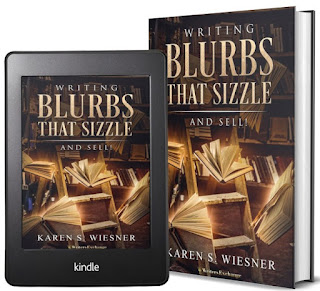
Karen S. Wiesner is the author of Writing Blurbs That Sizzle--And Sell!

Volume 7 of the 3D Fiction Fundamentals Collection 

http://www.writers-exchange.com/3d-fiction-fundamentals-series/

https://karenwiesner.weebly.com/writing-reference-titles.html 

Happy writing! 

Karen Wiesner is an award-winning, multi-genre author of over 140 titles and 16 series. Visit her here:

https://karenwiesner.weebly.com/

https://karenwiesner.weebly.com/karens-quill-blog

http://www.facebook.com/KarenWiesnerAuthor
Thursday, February 03, 2022

Gender Pronouns

Several years ago at a con session on the fantastic Pixar movie INSIDE OUT, starring personified emotions, someone in the audience asked why characters representing feelings had to be identified as male or female. Why did they need genders at all? The answer didn't occur to me until later: English doesn't have a neuter pronoun for a living, sapient creature. Since the characters of Joy, Sadness, Anger, Fear, and Disgust in the film couldn't be called "it," they had to be labeled either "he" or "she." French, Spanish, etc. classify all nouns as masculine or feminine, not just those that refer to living creatures, with pronouns to match. Some other languages such as German and Latin have masculine, feminine, and neuter. However, as I discovered more recently, this requirement to distinguish the sexes by grammatical gender isn't universal among Earth languages.

I was surprised to learn that many languages have no gender pronouns to identify male and female, e.g, Tagalog, Turkish, Estonian, and some Chinese dialects, among others. Some have grammatical gender categorized by traits other than biological sex, such as animate and inanimate. Here's the Wikipedia article on this topic:

Genderless Languages

The Wikipedia page on the broad subject of gender-neutral pronouns in languages with sex-linked gender distinctions, such as English:

Gender Neutrality in Languages with Gendered Pronouns

A detailed overview of grammatical gender, citing several examples that classify nouns according to criteria other than biological sex:

Grammatical Gender

An English speaker's mind is apt to be boggled by the vast number of personal pronouns in Japanese (mine certainly was upon my first exposure to this fact). Many are distinguished by degrees of formality. Not only third-person but first-person pronouns often have masculine or feminine connotations. Some are used predominantly by a particular sex but not always. And some are gender-neutral.

Japanese Pronouns

I don't hold with the Newspeak premise in NINETEEN EIGHTY-FOUR that language controls thought. (And I don't think many professional linguists nowadays accept that position.) However, available vocabulary does make it easier or harder to talk about certain concepts. I do wonder how American society might be different if English had no gender-specific pronouns. Would people who identify as nonbinary have an easier time if they didn't have to choose invented pronouns or the awkward singular "they"? Would transgender people have it easier if relieved of one difficulty, persuading others to refer to them by their preferred pronouns instead of the "dead" ones? I wonder how language affects such issues in countries with gender-neutral personal pronouns.

Margaret L. Carter

Carter's Crypt

Sunday, January 30, 2022

Say Again?

 "Say again" and "Come again" can be synonymous, depending on the context. Only the first is a potential synonym for "restatement", but when it comes to a restatement of copyright law --or any law-- one should not assume that the so-called restatement is true to the letter of the law.

As I remember it, Voltaire wrote in French, "If you would converse with me, you must first define your terms." Modern online dictionaries restate "would" as "wish to". 

By the way, Voltaire also wrote, "Toutes les histories anciennes, comme le disait un de nos beaux esprits, ne sont que des fables convenues."

Precis: History is no more than conventionally accepted fables (as one of our fine wits says).

And so, to a definition of the terms of copyright. Legal blogger Ava K. Doppelt, representing the law firm Allen Dyer Doppelt and Gilchrist PA has written a particularly clear an easy-to-understand explanation of copyright that begins with a quiz.

Everyone who thinks they know something about copyright should take that quick quiz.


Original link:

The trouble with the concept of copyright is that it has a dual purpose. Not only ia copyright intended to promote the advancement of art and science, but also  it is to incentivize scientists and artists to devote their time and talents to the arts and sciences, and to ensure that those who excel can earn enough by their creativity and skill to do their thing full time.

"Who in their right mind would write a book knowing that some tech company could nearly immediately publish an online version – without paying the author for the rights – because they think everyone in the world should be able to read that book?"

She opines that anyone who produces creative, copyrightable works ought to pay attention to the problems with the American Law Institute's Restatement of copyright project.  

Chris Castle of Music Tech Policy and also of Artists Rights Watch shares a telling transcript of an interview with a Spotify worker which goes to the heart of why--if one extrapolates-- there is a a desire in some quarters to restate copyright, for instance to make the case that streaming music, for example, is not copyright infringment.

https://artistrightswatch.com/2021/07/09/ashleyjanamusics-video-tells-you-all-you-need-to-know-about-spotifys-attitude-toward-artists/

"The Problem Is Not To Pay People Money"

The man says, "I think Taylor Swift doesn't need .00001 more a stream. The problem is this: Spotify was created to solve a problem. The problem was this: piracy and music distribution. The problem was to get artists' music out there. The problem was not to pay people money."

People who write books or make music, probably also like to buy food and pay the rent or mortgage. Copyright law is supposed to ensure that they earn enough from the works by being paid money! Streaming is proving disastrous for musicians, especially because of all the black boxes and frozen mechanicals.


All the best,