Saturday, May 14, 2022

Call Me Inaccessible...

As I craft my title for this week, a Frank Sinatra song is playing earworm in my head.

Back in 2012, I participated in a lengthy exchange of emails with Jim Fructerman of Benetech.org about his organization taking print books and converting them into braille, or otherwise making them accessible to book lovers with reading disabilities. With hindsight, I should probably have put up a link on my two websites... at least to the version of Insufficient Mating Material that Benetech put out in accessible form. I'm pretty sure that I made an audio recording (freely available) of Mating Net, but I am not sure how easy it would be for a listener to find it.

Do authors really need to worry about complying with the Americans with Disabilities Act? It's something about which I've rather buried my head in metaphorical sand. Does it make a difference whether or not an author sells books from her website?

Legal blogger Stuart K. Tubis of the law firm Jeffer Mangels Butler and Mitchell LLP explains the recently issued guidelines from the Department of Justice concerning website accessibility as it applies to state and local governments and businesses.

A copy of the Guidance document can be found here.

As Stuart K. Tubis explains:

"In the Guidance, the DOJ clarifies once again that the ADA applies to websites: “the Department’s longstanding interpretation of the general nondiscrimination and effective communication provisions applies to web accessibility.”

The Guidance also provides some examples of website accessibility barriers, including poor color contrast, lack of text alternatives for images, lack of labels for forms, and mouse-only navigation design.”

Lexology link: 
 
Original link: 

Unfortunately, as I see it, the DOJ may clarify that the ADA applies to websites, and it may give some examples of "barriers" that might offend, but it does not appear to set out whether or not single member LLCs and self publishing authors count as "businesses", or what exactly we minnows in the great writing pool might need to do to avoid falling foul of the ADA.

Another JMBM legal blogger, Martin H, Orlick, shares a great deal more information about ADA cases, and a horror story or two about alleged "serial plaintiffs" who are accused of filing thousands of ADA suits against small businesses including those owned by immigrants and minorities, with the apparent aim of exacting an average of $10,000 per business in settlements.

Legal bloggers Amy L. Bess and Mindy M. Wong of the international law firm Vedder Price offer five quick tips to help protect oneself from ADA-related litigation. They also lay out some disquieting statutory minimum fines for persons deemed to have violated the ADA.

Lexology link:
 
Original .pdf: 

Anyone who is a business entity, and who maintains a website should study the tips and discuss the issues with ones webmistress or webmaster... or weblover. Maybe, one should also discuss it with ones insurance agent or broker.

There is also a "bonus tip" which I think is a very good idea. It involves adding a "clickwrap agreement" to your website. They explain and give an example.

On an unhappier note, the always edifying, Angela Hoy of WritersWeekly shares a compelling blog by Emily Thompson: Three Common Reasons Why Freelancers Get Sued...

https://writersweekly.com/this-weeks-article/3-common-reasons-why-freelancers-get-sued-it-happened-to-me-by-emily-thompson?utm_source=mailpoet&utm_medium=email&utm_campaign=writersweekly-com-112119_67

For those not on MUSO's radar (they are a British-based piracy-fighting company), MUSO has released a study of the most pirated films this month. Apparently, movie piracy is up 42.5% compared with a year ago. Of all things, "Sonic The Hedgehog" seems to be one of the most pirated movies of all, which might tell you something about parenting.

They don't try to explain why, but might there be a relationship between the losses of subscribers seen by legal streaming services and the increase in piracy?

Piracy is not a "victimless crime". Some subscription services cut off the "credits" after the big names have scrolled, but in all likelyhood, anyone on the credits, down to the key grips, boom assistants, and drivers rely at least in part on the royalties for their livelihoods.

I wonder whether pirate sites comply with the ADA, and if not, why not?

All the best

Rowena Cherry 

SPACE SNARK™ 
EPIC Award winner, Friend of ePublishing for Crazy Tuesday

Friday, May 13, 2022

Karen S. Wiesner: SURPRISES IN THE COURSE OF LEARNING TO WRITE A SCIENCE FICTION SERIES (3 of 15)

 Surprise #1: Of Not Having to Reinvent the Wheel For Everything


This is the third of fifteen posts dealing with surprising things I learned in the course of writing a science fiction series.

In the first part of this series, I mentioned that one of the fundamentals I was told about the "right way" to write science fiction was by adhering to what seemed to be to be the cardinal rule of the genre: That all science fiction stories have to include a concept of legitimate science or technology that can somehow be applied to fictional theories or ideas that could become future realities. Without fail, every single writing manual and article I read about how to write science fiction included this regulation. This is in the same vein as "write what you know" but of course is it really necessary or even ideal for a writer to limit himself in such a way? [Read Margaret L. Carter's February 10, 2022 post about just this if you want a unique look at this theory: https://aliendjinnromances.blogspot.com/2022/02/most-writers-are-writers.html]

I don't dispute that scientific and technologic realism are important so much as I wonder how much it can be bent. We are writing fiction, after all. In his Biographia Literaria, William Coleridge coined the phrase "suspension of disbelief". In this "poetic faith" state of mind, readers voluntarily ignore obvious untruths and fantastic elements in order to enjoy the story unfolding before them. So, if an author can legitimately make readers believe something that's impossible in the real world is actually happening in the fictional story, anything goes, right?

When an author goes into writing science fiction, there are a lot of "Standard Operating Procedure" facts that have to be established and explained about this time period and their unique world or universe--in a way that readers are able to suspend belief and just go with it, regardless of how implausible in our current world and time. For example, if your characters travel through space on a regular basis, you usually have to explain how they're doing it.

Luckily, many amazing authors have already written about fascinating concepts based on scientific principles and existing and experimental technology, such as using wormholes, folds in the fabric of space, or some other creative explanation that provides the means of skipping, folding or warping space to allow jumps across great distances--all that do factor in the theory of relativity, time dilation, and interstellar travel. I call these "established knowns", and they provided one of the first surprises I received when I started writing science fiction. Namely that I could use these "established knowns" because they're basically plausible explanations that are already accepted by the majority of science fiction readers who devour extremely popular science fiction books, movies, and television series like Star Trek, Star Wars, Mass Effect, and The Expanse. Cool! I needed to hear the good news that there can be some shortcuts in this complicated undertaking. But keep in mind that most writers don't want to and shouldn't use them verbatim. That would be copying and could lead to all kinds of moral and legal issues. However, simply basing your tech and world principles on established knowns is allowed. You have to find a way to creatively adapt established knowns to make them unique to your story and series.

Since my series was set in the not-to-distant future, I really did have to have an explanation for how Humans got their technology to travel through space. I creatively used some established knowns to explain their space travel and communications, as well as coming up with realistic, futuristic orbital habitations, credible revelations about dark energy and matter, and legitimate reasons for what might force Humans to leave Earth to explore and find homes in space or on other planets. All of these were treated as Standard Operating Procedures for my series. Rather than reinventing the wheel for all of these things, I laid down my foundations as simply and believably as I could based on creatively adapted established knowns.

The surprise that I didn't have to reinvent the wheel for every single scientific and technical aspect was certainly one of the most welcome I had. It saves so much time and energy to utilize the concept of established knowns. I realized almost from the start that forcing myself to come up with brand new, exciting and extra creative ideas to explain the "SOP" of my series would have been overwhelming not only for me as the author (having to figure all this out when I'm most definitely not a scientist of any kind in the real world!), but also overwhelming for the readers who would have to hear endless and overly complex and potentially boring explanations about how everything worked from A-Z here in my particular galaxy. I've found over the years that the science fiction stories I like following the **least** are the ones that spend way too much time trying to explain to me the Standard Operating Procedures for their universe. I don't think I'm that different from other sci-fi readers: In a fiction book or series, I want to be impressed by the creativeness of the story, not scientific theories.

In Arrow of Time, the space travel and communication SOPs weren't exactly the same as for any other series, and I think that's important because, to me, just saying my characters have warp drive, like in Star Trek, felt like cheating. What I did was figure out what's been done already and what's plausible, and, from there, I played around with the concepts until they fit my series and made sense in it. Creatively utilizing established knowns, I could put my SOPs in place as briefly and intriguingly as possible and then I could roll out my story.

Another reason for not reinventing the wheel for every little aspect of your science fiction story is that these things you labor to create can easily become focal points. If that's what you intended, great. But if it's not, you went to a lot of elaborate trouble to develop and explain them yet they're not factoring greatly into the storyline somehow. That doesn't make sense and could be frustrating for readers. In my series, those SOP aspects weren't majorly important. I wanted them to be legitimate and credible, but I didn't want them to call more attention to themselves than was necessary. All I wanted was for the "poetic belief" to kick in for readers so I could move forward with the storytelling.

Over the course of the next two weeks, we'll talk about research and developmental tools in writing science fiction.

Happy writing!


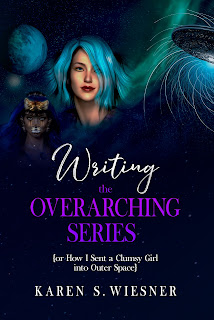
Based on Writing the Overarching Series (or How I Sent a Clumsy Girl into Outer Space): 3D Fiction Fundamentals Collection by Karen S. Wiesner (release date TBA)

https://karenwiesner.weebly.com/writing-reference-titles.html


http://www.writers-exchange.com/3d-fiction-fundamentals-series/

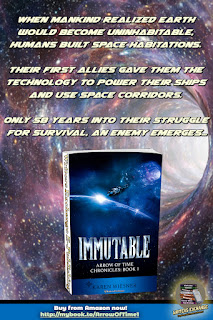
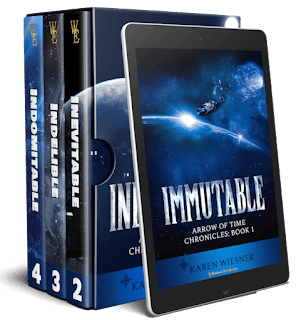
Karen Wiesner is an award-winning, multi-genre author of over 140 titles and 16 series, including the romantic science fiction series, ARROW OF TIME CHRONICLES

https://www.writers-exchange.com/arrow-of-time-chronicles/

https://karenwiesner.weebly.com/arrow-of-time-chronicles.html

http://www.facebook.com/KarenWiesnerAuthor

Thursday, May 12, 2022

Writing to the Future

Cory Doctorow's latest LOCUS column, on writing nonfiction pieces that will still be relevant by the time they're published:

Six Weeks Is a Long Time

The time lag that may undercut the applicability of a written work, according to him, seems to be getting shorter. Circumstances can always truly change overnight or in an instant, of course. Consider the difference between September 10, 2001, and September 11 of that year. Yet it may seem odd to define an essay meant to be read a month and a half after it's written as "futuristic thinking." The near future, however, is still the future. As C. S. Lewis's senior demon says in THE SCREWTAPE LETTERS, all human beings constantly travel into the future at the rate of sixty minutes per hour.

I once read a story about a time-viewing machine that allows the user to look into the future. The culture-transformative feature of this device is that it has no lower limit on how short a time span it can look ahead. And apparently (if I remember correctly) one can view events in other places, not just where one happens to be personally located. Suppose you peer ten seconds into the future? You're effectively spying on people's actions in the present, in real time. (On second thought, it may have been a past-viewing device. Same principle applies.)

Doctorow wrote this month's article in the midst of a new, highly contagious COVID variant and the imminent invasion of Ukraine, addressing us "in the distant, six-week future" from his moment in the past when "the odds of nuclear Armageddon [seemed] higher than they’ve been for decades." He greets his future audience thus: "I bear glad tidings. Only six weeks ago, you, me and most everyone else we knew couldn’t imagine getting through these next six weeks. If you’re reading these words, you did the unimaginable. Six weeks and six weeks and six weeks, we eat the elephant of the unimaginable one bite at a time."

We're familiar with the question of what message we'd like to send to our past selves. There's a country song about writing a letter to "me at seventeen." But what message might you want to send to your future self? Unlike speaking to one's past self, this we can actually do. Are there important events or thoughts you might want to write down as reminders in case you've forgotten them a month, a year, or decades from now? What would you like to record as an important reminder for the citizens of your city, your country, or the world next month, next year, a decade from now, or generations later? People often do the latter with physical "time capsules." Would the things you choose to highlight turn out to be important to those future audiences or not?

Isaac Asimov wrote at least one essay predicting future technological and social advances, and surely he wasn't the only SF author to do that. Some of his predictions have come true; many haven't. An essay like that could be considered a message to future generations.

Margaret L. Carter

Carter's Crypt

Saturday, May 07, 2022

Kick Back

The prevailing theme on the copyright-related legal blogs this last week dealt with recent DOJ guidance for website owners.  More of that, maybe, next time. Meanwhile, and more urgently, there are three free events this coming Wednesday, May 11th, and another event on May 16th.

If you are an author or an aspiring author, but not yet a member of the copyrightalliance.org (membership is free), or of AuthorsGuild.org (membership costs around $135 pa)  or of SFWA.org (membership around $100 pa) you might not have heard about the creators conference.

https://graphicartistsguild.org/creators-conference

From 11.00 to 12.30 am ET, a distinguished panel discusses the shocking (to some) details of how authors, artists, designers, songwriters, photographers, illustrators, composers and more are beguiled into working for free, or even paying in order to work for others.

The second panel runs from 1.30 to 3.00 pm ET and discusses some of the dirtiest tricks in contracts, including how "work for hire" wording can strip one of ones copyright, and lock one into a bad deal.

 
The third panel is between 4.00 and 5.30 pm Eastern, and reveals some of the ways that infringers steal works, and companies engage in "rights grabs"... and how to fight back to keep what is yours.


The CopyrightAlliance is hosting a webinar on May 16th from 2pm to 3.15 pm Eastern, in conjunction with Texas Accountants and Lawyers for the Arts, and the American Society of Media Photographers to explain how the Copyright Claims Board works to resolve certain copyright disputes.

https://us02web.zoom.us/webinar/register/WN_hOibv5MURNOS8iWBNwQ7Ew


Something one can do, if so inclined, is to support the SMART Act that was introduced by Senators Thom Tillis and Patrick Leahy in March of this year.

https://www.tillis.senate.gov/2022/3/tillis-and-leahy-introduce-bipartisan-legislation-to-combat-copyright-piracy-enhance-content-sharing-and-hold-tech-accountable

https://www.tillis.senate.gov/services/files/BBDBFA87-17CA-4D15-AA0F-9B54BFEEA31D

One show support, for instance, by writing a note to your own senator, or to the sponsoring senators, or following some of the ideas here.

All the best,


Friday, May 06, 2022

Karen S. Wiesner: SURPRISES IN THE COURSE OF LEARNING TO WRITE A SCIENCE FICTION SERIES (2 of 15)

 Of the Overarching Series and Its Connection to Speculative Fiction

This is the second of fifteen posts dealing with surprising things I learned in the course of writing a science fiction series.


 A timeless universal truth:

No simple solutions, no easy answers, and nothing is ever free…

In last week's post, we talked about why science fiction, especially those in a series, is debatably the most difficult genre to write in. Another reason this type of series is so complicated is because it's part of a rare breed of series that I'm calling the Overarching Series that requires complex and multifaceted character- and world-building as well as necessitating series arc sequel hook endings in all but the final installment. Overarching Series dominate speculative fiction more so than any other category of fiction, though it is possible for one to be in other genres as well.

In the Overarching type of series, none of the books can truly be standalones because the series arc that's introduced in the first book in the series will run through every installment in that series, expanding and intensifying as it goes, only concluding in the final volume of the series. In other words, it's unlikely that the individual titles of the series (except perhaps the first) can be fully understood without the others in that series. Nearly always, they need to be read as a set, in the proper order, to make sense. However, that doesn't necessarily mean that you can't enjoy the stories separately. You'll just miss a lot doing so and ultimately you might end up with a fair amount of confusion.

To be clear about this, a cliffhanger ending is most always referring to when a book ends in the middle of an unbearably intense or emotional bit of danger. Instead of concluding at the place where the scene would reach a natural end, the action is truncated prematurely, leaving the reader hanging when it comes to resolution. Readers have no way of knowing what actually happened unless or until a sequel to address this dangling thread is released and addresses the previous situation satisfactorily (and sometimes the explanation for how the danger was actually averted can be less than gratifying). Frequently, readers consider employing this technique as outright cheating because they've been purposely deprived of the unspoken promise of a proper resolution.

Kind of a downgraded definition of a cliffhanger ending is any thread left dangling. In the case of series arc thread, writers generally provide story arc resolutions within the individual volumes of the series while holding off on resolving series arcs until the final volume. For the purposes of my upcoming writing manual, Writing the Overarching Series, I'm calling these not-quite-a-cliffhanger endings "series arc sequel hooks". While readers maybe shout "But what happened to--?!" upon reaching the end of any series installment, the place each particular volume ends should feel natural and not an affront or trickery employed to avoid genuine resolution. 

The story arcs that are specific to individual titles in an Overarching Series will resolve within their particular book, providing the necessary satisfaction when completing the story, while the series arc almost always produces a less upsetting form of cliffhanger ending called series arc sequel hooks in all volumes other than the final book of that kind of series, where it's finally resolved. The reason for that may be obvious but I'll state it anyway: The series arc can't be resolved until the last book of the series. While authors do need to find a natural, logical place to leave the series arc from one volume to the next so the "to be continued" aspect won't infuriate readers so much as build anticipation for what's to come, keep in mind that each volume needs to be assigned its own piece of the series arc to tell in an Overarching Series. Some well-known Overarching Series book series, TV series, and movies are The Lord of the Rings, Divergent Series, Harry Potter Series, Twilight Series, Supernatural, Grimm, and Star Wars.

Another interesting thing about Overarching Series is that an Overarching miniseries (or more than one) can exist within an existing series of stories that could otherwise be considered series standalones. In literary terms, a miniseries is most accurately referring to a finite set of stories told within an existing seriesBoth the Star Wars and Star Trek series have quite a few Overarching miniseries along with standalone stories. Star Wars original miniseries included three stories in a trilogy: Star Wars (sometimes also called A New Hope), The Empire Strikes Back, and Return of the Jedi. Rogue One and Solo are individual stories within the series. Star Trek has a host of miniseries within the Overarching Series, including but not limited to The Next Generation, Voyager, and Discovery. In my Woodcutter's Grim Series (fantasy/paranormal/mild horror), I have two miniseries that qualify as Overarching Series within the overall series. One of the Overarching Series is untitled and deals with the Shaussegeny Curse (Books 4-7). Another is called Bridge of Fire, Book 10, which has three separate novel parts. Books 1-3, 8, 9 and The Final Chapter could be considered standalone titles within the series.

Perhaps the most defining factor of an Overarching Series is that the individual volumes could easily and maybe even should be ideally packaged as a single work if cost and reader acceptability weren't factors.

You might have noticed something very specific about all the Overarching Series titles I mentioned above: They could all be included under the Speculative Fiction umbrella. Speculative fiction is particularly well-suited to the Overarching Series structure. While it's certainly not out of the realm of possibility that an Overarching Series could fit in other genres of fiction, they do crop up most often in speculative fiction. All the techniques and strategies I employed in the process of completing my Arrow of Time Chronicles are actually ones that could work just as well for any fiction genre as well as for any type of series.

Let's talk more about the speculative fiction before we get into why these particular genres work so well for an Overarching Series.

There are a lot of different definitions for speculative fiction (or "spec fic" as it's sometimes called). Basically, the definition I'm using here is the one that's most likely to come up if you put the words "speculative fiction" into any search engine: "A genre of fiction that encompasses works in which the setting is other than the real world, involving supernatural, futuristic, or other imagined elements." The spec fic umbrella would cover (but isn't limited to) science fiction, fantasy, superhero fiction, science fantasy, horror, utopian and dystopian fiction, supernatural and futuristic or any combination of these along with other potential offshoots too numerous to mention. The point is, spec fic almost always has enormous requirements when it comes to:

            1) World building. You might need to come up with a variety of environments either all in one location, like a planet, or sprawled across great distances--maybe an entire universe--that you have to figure out how to traverse. Most if not all of these locations have to be unique and complex enough to be believable while still retaining some semblance of realism capable of luring current readers.

            2) Character building. In these genres, not all your characters will be human. In fact, a good portion might be from an alien culture or some kind of supernatural creatures that the author has to construct from the ground up. You're not just describing and personalizing living and breathing, sentient beings. You're figuring out who and what they are, where they came from (their history, present day situation, and the future are yours to formulate!). You'll be required to explain how their family life, culture, government, religions, monetary systems, and countless other structures work in their very individual worlds.

Overarching Series are frequently utilized in genres under the speculative fiction umbrella. However, not all speculative fiction series are Overarching Series. The reason for that is because you can easily have standalone series titles in a speculative fiction series. Trust me, we'll figure this all out in the next few months and it'll make perfect sense when we're done. We'll also talk more in-depth about story and series arcs, types of series, and standalones, and cliffhangers in later posts.

Next week we'll talk about my very first big surprise in writing a science fiction series.

Happy writing!


Based
on 
Writing the Overarching Series (or How I Sent a Clumsy Girl into Outer Space): 3D Fiction Fundamentals Collectionby Karen S. Wiesner (release date TBA)

https://karenwiesner.weebly.com/writing-reference-titles.html

http://www.writers-exchange.com/3d-fiction-fundamentals-series/

Karen Wiesner is an award-winning, multi-genre author of over 140 titles and 16 series, including the romantic science fiction series, ARROW OF TIME CHRONICLES

https://www.writers-exchange.com/arrow-of-time-chronicles/

https://karenwiesner.weebly.com/arrow-of-time-chronicles.html

http://www.facebook.com/KarenWiesnerAuthor