Thursday, May 05, 2022

RavenCon 15

This year's was the first RavenCon since 2019. They moved from Williamsburg, Virginia (where we attended for three years before the lockdown began) to a new location just north of Richmond, the same general area as their original home base. It was the first time at that hotel, though. The facility consisted of three large buildings with red brick, colonial-style exteriors in a beautifully landscaped setting. Luckily, the weather stayed nice enough for walking between buildings, aside from a slight chill the first couple of days. The hotel provided buffet meals from Friday morning through Sunday morning. That's always a big plus at a con, because we can eat at our own pace and not be late for panel sessions.

Guests of honor were author Terry Brooks and filk singer Rhiannon's Lark. Staff and people on the program had an opportunity to get books signed by Terry Brooks on Friday morning, a few hours before the official opening of the con. That gathering didn't have a big crowd, so he chatted a bit with each person who brought books for him to sign. He's a very nice guy. Later in the weekend I attended an interview in which he gave a lot of interesting information about how he sold his famed first novel, SWORD OF SHANNARA, and the twists in his later career. In addition to hearing a full-length performance by soloist Rhiannon's Lark plus two brief interludes (at the opening ceremony and the costume contest), I watched filkish duo Nefarious Ferrets. In both cases, I could understand the lyrics (not always a given!), liked the singers' voices, and enjoyed the songs' contents, both funny and serious.

Les (my husband) and I, along with one other couple, presented a panel on creative collaboration in marriage. We had a lively discussion, and I thought it went well. I appeared on two other panels, one on the appeal of vampires and one on paranormal romance. Les participated in sessions on "mid-story blahs," combat in speculative fiction, and hypothetical energy sources of the future. I watched the last few minutes of a slide presentation by a man from Richmond's Poe Museum, about Vincent Price's Poe-related movies; I wish I'd been able to see all of it.

All the costumes at the masquerade struck me as impressively elaborate. Even though I recognized the sources of almost none, most being based on video games, I enjoyed and admired them. My only complaint about the event was that sometimes the background music was too loud.

We came away with a good impression of the hotel. Despite its single major flaw, the lack of an auditorium, only one event—the masquerade/costume contest—was so crowded that standing latecomers lined up against a wall. Since the location is closer to home for us than the previous hotel, I hope RavenCon stays there for a long time. Especially because it takes the entire weekend to learn the layout of a new venue, and I don't want the effort wasted. :)

You can read all about the convention and view the program schedule here:

RavenCon

Margaret L. Carter

Carter's Crypt

Sunday, May 01, 2022

False and Loose

The copyright-related legal blogs from last week are particularly fascinating for authors of all kinds of fiction, including alien romance writers.... and for fans of the Italian philosopher and statesman Niccolo Machiavelli.

I like to think that the author of history's most famous book on dirty politics would have approved of the legal notion that, in America, under the First Amendment, "false speech is protected..."

Legal blogger Benjamin E. Marks of the international law firm Weil Gotshal and Manges LLP, pens a spotlight on free speech and media freedom in the USA (which is an except from a larger media and entertainment law review article.)

Lexology link:

Benjamin E. Marks begins with a masterful explanation of The First Amendment (which limits government interference with American citizens' right to free speech.)

"The First Amendment to the US Constitution provides strong (but not absolute) protection to all forms of speech. As a general matter, 'government has no power to restrict expression because of its message, its ideas, its subject matter, or its content'."

He goes on to explain the few and limited exceptions that are not protected, and also mentions a few obnoxious (my word) categories that the government has attempted to unshield without success. Please follow the link for the details.

Next, Mr. Marks discusses false speech, other forms of objectionable speech, and the fact that it is mostly protected!

"False speech is protected unless it involves defamation, fraud or some other legally cognisable harm; falsity alone is not enough.5 Hate speech is also protected, reflecting the bedrock principle that the government 'may not prohibit the expression of an idea simply because society finds the idea itself offensive or disagreeable'.6 The First Amendment affords special protection to 'even hurtful speech' when it concerns a public issue to 'ensure that we do not stifle public debate'.7"

The First Amendment applies only to government, and not to private businesses. The line about special protection for hurtful speech reminds me of the quote attributed to French philosopher Voltaire, and often loosely translated and reported as: "I disagree with what you say, but I will defend to the death your right to say it."

Columnist David Hunter wrote an opinion article on how quotations become tangled.

It's worth noting in passing that authors and bloggers may be forgiven for innocently mangling a word or two within an otherwise accurate quote, but cobbling together a-quote-that-never-was is risky.

Credit to writersweekly for the news link.

As for publishers, they usually skate on liability. The legal buck stops with the writer and his or her sources if information of disputed accuracy is acquired without the consent of the original owner. Under maritime law, if a compromising diary is found on a beach, it matters whether it is flotsam or jetsam, for instance.

The copyright of letters, diaries, yearbooks, texts etc. belong to the author, not to the recipient nor to the finder, purchaser, or incidental acquirer, for instance.

Mr. Marks writes:

"However, a publisher cannot be held liable for the unlawful procuring of information by a source if the publisher was not involved in the illegal conduct...."
 This is really interesting for writers. Books, newspapers etc are not classed as commercial speech simply because they are sold to the public.

"... media and entertainment products are not commercial speech merely because they are distributed or sold as part of for-profit enterprises.13 Accordingly, even false media reports are generally not actionable under consumer protection laws.14"

Then, there is the matter of whether or not untruths in advertising (my words) are protected false speech depending on their audience.

Legal bloggers Kyle-Beth Hilfer and Sarah Sue Landau , experts in advertising law, of the law firm Cowan Liebowitz and Latman PC  discuss "Dark Patterns" in advertising, with especial emphasis on false urgency, for instance on commercial sites in the travel industry.

“Almost sold out.” “Act now.” Such marketing messages, conveying urgency to purchase, led to a $2.6 million settlement with the Attorney General of New York over deceptive marketing practices..."

So begins their Advertising Law Alert.

Original link:
 
Lexology link:

Allegedly, with the purpose of creating a sense of urgency, the travel-related platforms in question might display..

 "fictitious messages indicating the number of tickets left for a flight or a percentage of hotel rooms available at a certain price, and would prompt consumers to “book now.” For example, if a consumer was searching for a single ticket from New York to Toledo, she would see a message that there were only two tickets still available when, in fact, there were many. Consumers were thus misled to believe that time was running out to purchase the deal."
Any author looking for flights to the next author conference, or reserving a room might well wonder. We've probably all seen those "urgency" messages.  For more insights into the sexily-monikered "Dark Patterns" follow the links.

Plagiarism is also a form of false speech. Many authors have some insight into how it feels to be plagiarised, and given the conveniences of the internet, it has become increasingly easy to cut and paste someone else's work from online.

In Turkey, plagiarism is also known as pilferage.

From Istanbul-headquartered law firm Gun and partners comes a very interesting article on the concept of plagiarism. They do not credit an individual author.

Original link:
 
Lexology link:

Quoting them:

"Although plagiarism is not clearly defined in Law No. 5846 on Intellectual and Artistic Works (LIAW), it is one of the most common acts of infringement. Plagiarism, which is defined as “pilferage” by the Turkish Language Association under the law on intellectual and artistic works, is used to “present someone else’s work as your own, taking a piece from someone else’s work without citing the source”.

Much to consider.

All the best,


Rowena Cherry 
SPACE SNARK™  
EPIC Award winner, Friend of ePublishing for Crazy Tuesday


Friday, April 29, 2022

Karen S. Wiesner: SURPRISES IN THE COURSE OF LEARNING TO WRITE A SCIENCE FICTION SERIES (1 of 15)

 Introduction: In Which an Old Dog Learns a New Trick

This is the first of fifteen posts dealing with surprising things I learned in the course of writing a science fiction series.

I write (and I'm published) in nearly every genre of fiction you can imagine. Science fiction horror is my favorite genre to read, and I'd always wanted to write in that genre. Though I'd written mild horror and many speculative fiction titles, science fiction was new for me before I decided to embark on what felt like an epic quest when I started the Arrow of Time Chronicles. At that time, I'd been published author for more than 20 years, and this old dog was about to learn quite a few new tricks.

 
 A timeless universal truth:

A timeless universal truth: No simple solutions, no easy answers, and nothing is ever free…

Long before I actually had any specific ideas about potential science fiction plotlines, I was talking to my son and husband about wanting to write something like Star Trek and having my Clumsy Girl Zoë Rossdale (of Clumsy Girl's Guide to Falling in Love and Clumsy Girl's Guide to Having a Baby) onboard the spaceship. My son, especially, thought it was brilliant and encouraged me to make it happen.

Fast-forward a few years and finally I'm getting ideas for a science fiction series. The premise I started with was a sci-fi saga set not too far in the future when mankind has finally begun traveling the stars, mainly in desperate and dire need of finding new homes for the population stranded on Earth following the Great Catastrophe (basically, Climate Change reaching the critical point). What if Humans built orbital habitations for their people not only in their own planet and moon's lagrange points (you can do a search for what these are if you need to) but also in the L-points of other planets and moons all over the galaxy? In the course of constructing these space dwellings suitable for Humans, what if one of the moons and planets they build above is in a nuclear winter and there are actually survivors down on the planet below? What if there are others originally from the planet who'd achieved space travel before the war that destroyed their planet and these hostile Napoleonic aliens return to their homeworld to find Humans "squatting" in their territory?

That catalyst is what led me to writing this series, but another thing that compelled me was the idea of having cultures (what I call the alien races populating my series) spread across the galaxy that, genetically, are so similar, it begs a billion scientific, cosmological, and theological questions.

The horror angle I wanted to develop in this series turned much milder than I intended in the form of phantom energy--an unconscious force of dark energy--dominating and "expanding" like a space-eating tumor throughout the universe. Eventually, its rapid destruction spreads everywhere and threatens all life in the galaxy.

In case you're wondering, yes, my Clumsy Girl Zoë's descendant, Astoria "Tori", is on board the Aero spaceship, klutzing it up in the most endearing way!

Before I started writing my Arrow of Time Chronicles, I believed science fiction had to be the most complicated genre imaginable. Not only do you as an author have to create all types of characters, but most of the time they're part of an alien race that hails from a different part of the galaxy altogether. World building becomes *universe* building. Gulp! And technology…wow, where do I even start? It's no wonder a lot of sci-fi authors are scientists (Isaac Asimov, Arthur C. Clarke, Fred Hoyle) 'cause, frankly, who else can really understand all these things? Intimidation galore!

Of all genres, I think science fiction also has the most opinionated authors. I tease a bit here, but seriously I don't believe in placing too many regulations on writers. If an author can get something to work in a story, then who cares about some long-standing rule that says no, you cannot do that here? How many other genres are you told from the get-go that, as a writer, you absolutely should not dare to change something that's been as established the cardinal rule? Additionally, you're also told that all your science and tech better be legit…despite that…{clearing throat here} you're writing **fiction**.

While I was writing my Arrow of Time Chronicles over about 2, 2 1/2 years, I found out in the process of learning everything I could and in some ways teaching myself how to go about the process of understanding the mechanics of writing in this genre that science fiction was definitely the most complicated genre imaginable. There was so much to absorb, so much to construct, so many ways to go wrong and have it all fall apart.

After I was done writing my sci-fi series, I felt a whole kaleidoscope of emotions about writing science fiction: Triumph, relief, awe, sorrow, complete and utter exhaustion. And, my conclusion was, yeah, science fiction is the most complicated genre imaginable--hands down! There is simply no comparison. Even mysteries, police procedurals, and action-adventures were a walk in the park compared to this genre. I learned so much in the course of writing my sci-fi series. Before I ever started writing Arrow of Time Chronicles, I read every book I could get my hands on about how to write in this genre. Yet I was left with quite a few curve balls that I couldn't have foreseen. I knew I had to overcome these things if I had any hope of accomplishing this epic undertaking that promised to bring about my magnum opus.

The posts in this long series coming to Alien Romances blog are the basis for my writer's manual titled Writing the Overarching Series (or How I Sent a Clumsy Girl into Outer Space), which will be included in my 3D Fiction Fundamentals Collection. In the posts that follow in this series over the next three months, I'll go over the surprises I had in the course of writing my first science fiction series, including the following topics:

·         Of the Overarching Series and Its' Connection to Speculative Fiction

  • ·        Surprise #1: Of Not Having to Reinvent the Wheel For Everything

·         Of Research and Developmental Tool Requirements, Part 1: Surprise #2: Research Overwhelm

·         Of Research and Developmental Tool Requirements, Part 2: Surprise #3: Development Tool Underwhelm

·         Surprise #4: Of Deliberately Limiting Story Potential Development

·         Of Arcs and Standalones, Part 1: Story Arcs

·         Of Arcs and Standalones, Part 2: Series Arcs

·         Of Arcs and Standalones, Part 3: Establishing a Series Arc Early in the Writing Process

·         Of Arcs and Standalones, Part 4: Establishing Story Arcs Early in the Writing Process

·         Of Arcs and Standalones, Part 5: Surprise #5--Why Standalone Series Stories May Be Impossible in the Sci-Fi Genre

·         Of Arcs and Standalones, Part 6: Cliffhangers and Conclusions

·         Of Lessons Learned 

·         Of Rewards Earned

·         In Which a Clumsy Girl Goes into Outer Space

Happy writing!


 Writing the Overarching Series (or How I Sent a Clumsy Girl into Outer Space): 3D Fiction Fundamentals Collection by Karen S. Wiesner (release date TBA)

https://karenwiesner.weebly.com/writing-reference-titles.html

http://www.writers-exchange.com/3d-fiction-fundamentals-series/

Karen Wiesner is an award-winning, multi-genre author of over 140 titles and 16 series, including the romantic science fiction series, ARROW OF TIME CHRONICLES

https://www.writers-exchange.com/arrow-of-time-chronicles/

https://karenwiesner.weebly.com/arrow-of-time-chronicles.html

http://www.facebook.com/KarenWiesnerAuthor

Thursday, April 28, 2022

Ascendance of a Bookworm

That's the title of a Japanese novel, manga, and anime series by Miya Kazuki. (I've been reading/viewing all three formats simultaneously, as installments become available, with the result that I sometimes get confused as to the progress of the plot since they've all reached different points in the story.) I've never come across anything quite like this story's intriguing premise: A Japanese college student obsessed with books—even more than I am, if that's possible—ironically gets killed by having a bookshelf fall on her during an earthquake. With her dying breath, she prays to get reincarnated in a world full of books. The gods apparently have a dark sense of humor, for she wakes up in the body of a sickly five-year-old girl named Myne, the younger daughter of a poor, illiterate family in a preindustrial world. (It's implied, though never explicitly confirmed, that the "real" Myne died during her latest attack of illness, leaving her body vacant for the heroine to enter.) Books are rare, hand-copied, expensive, and owned only by the clergy, nobles, and very wealthy commoners. Myne determines that if she can't acquire books any other way, she'll make them herself. Paper and ink, however, are also scarce and expensive, so she has to figure out how to make those products first. Fortunately, she gets a head start from extensive reading about the history of printing, along with her prior-life varied experience dabbling in arts and crafts. Still, as a five-year-old girl prone to collapsing whenever she exerts herself, she has an uphill battle even convincing anybody to take her wishes seriously, much less gathering the materials she needs. In the course of her "ascendance," she not only manages to introduce movable-type printing to her new environment and spread literacy, she also achieves what I think the "gods" might have intended by placing her in this world: As well as continuing to love books, she also learns to value relationships with people. Along the way, readers pick up a lot of incidental knowledge about the manufacture of paper and the process of printing.

The further I delve into this series, the more Myne's plight seems to resonate with some real-world analogs. While she knows herself as an educated adult on the inside, at first everybody else sees her as a lower-class, perpetually sick, fairly useless child. In this quandary, she brings to mind people suffering from disabilities that make communication painfully difficult even though their minds are as sharp as anybody's. Or transgender people whose outward appearances conflict with their core gender identity.

On a more personal level, I can identify with Myne from childhood and teen years as a bookish academic overachiever who got no respect from her parents aside from a few minutes once every six weeks during the school term, when report cards were distributed. Now, in old age, I realize the adults knew many important things to which I, as a child and teenager, was oblivious. Yet, in retrospect, I remain aware that I wasn't totally wrong to think I did know some things my parents didn't.

This heroine also reminds me of my early experiences as an avid reader of horror, fantasy, and science fiction—all that "crazy stuff." Nowadays that field of interest is probably considered less "weird" than in the 1950s and 60s. Nevertheless, I believe most lovers of speculative fiction share the feeling of not fitting into the mundane world around us, of being aliens whose true home is elsewhere. Maybe that's why we started to read fantasy and SF to begin with.

Margaret L. Carter

Carter's Crypt

Saturday, April 23, 2022

Cop Music

This takes the biscuit for copyright-infringement-related theories about music-loving motorway enforcement:

Nicholas J.Krob, legall blogger for McKee Voorhees and Seese PLC analyses what might or might not be a "thing" and the motorways of America, and why you should keep your ears open.

https://www.filewrapper.com/we-dont-talk-about-accountability-police-attempt-to-hide-behind-disney-music/

https://www.lexology.com/library/detail.aspx?g=ef1ff90e-b44b-42ac-9f50-bf9e3647d6aa

If the Lenz baby can dance to pop music, and the dancing is fair use, and even transformative, then whatever interactions take place between a motorist and a peace officer to a background playlist emanating from a protecting and serving vehicle is probably not going to be taken down if posted (by an indignant motorist) on the internet on the grounds of copyright infringement.

Here's how Brandon W. Clark explains copyright. 

Meanwhile, in New York workplaces, employers who wish to police whatever their employees are enjoying during work hours on devices in the workplace (including music), are required to give the employees written notice.

Legal blogger Frank J. Del Barto of Masuda Furnai Eifert and Mitchell LTD  discusses the policy.

https://www.masudafunai.com/articles/masuda-funai-employment-newsflash-new-york-employers-must-provide-notice-before-monitoring-email-or-internet-use

Given that many data breaches seem to begin with an unwary worker clicking an unsafe link on the internet and opening the door to malware, this seems quite sensible.

All the best,

Rowena Cherry  
SPACE SNARK™

Friday, April 22, 2022

Karen S. Wiesner: The Pick-up-the-Pace Ploy for Writers

 Writer's Craft Article by Karen S. Wiesner

The Pick-up-the-Pace Ploy for Writers

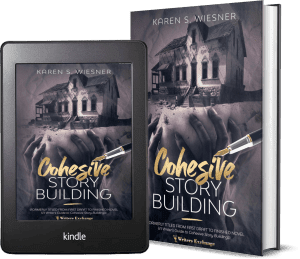
Based on COHESIVE STORY BUILDING (formerly titled FROM FIRST DRAFT TO FICTION NOVEL {A Writer's Guide to Cohesive Story Building}) 

While at one time in writing, it was popular to have long scenes. These days, shorter scenes are in fashion, and I feel there's good reason for that. If you want your book to be read swiftly, with pages flying, you can write one scene per chapter and keep those scenes short, with a single theme or purpose—this is an effective way to keep your readers from noticing they’re sitting in the real world with a book in their hands. In fact, your readers probably won’t even notice you're doing these things on a conscious level.

Short scenes accomplish several things:

Ø  In the most obvious sense, fairly short chapters allow the book to move along swiftly from one chapter to the next. Try reading a James Patterson thriller (and possibly his stories in other genres) if you want to see how this works in an almost shocking way. I won't deny that the brevity in these stories at times compromises dimensionality a little or a lot. However, if you want to see how pages can fly, you'll get that with his stories.

Ø  When chapters are short, there's generally a single focus. In other words, the scene has a singular purpose, a goal to achieve. The complication to the reader is minimal. He absorbs the premise easily and is ready to move on from that point when it's time. In the ideal that an author should continually be striving for, he'll get a hint of "future dimension" that will provide him with the eagerness to keep going.

Ø  Your reader is likely to read more in one sitting, since many will glance ahead to the next chapter when considering whether or not to stop reading for the time being. If the next chapter is short, he'll be much more inclined to read “just one more” chapter. Frequently, he won’t put the book down for several more short chapters.

Ø  Short scenes may produce more reviews that are likely to include comments like “page-turner,” “nail-bitter,” and “couldn’t put it down.” Who doesn't want that?

For example, Tracy Chevalier’s Girl with the Pearl Earring has no specific chapters or scenes. However, the book is divided into four parts, each based on a year in the life of Griet, the main character. Each scene within those parts is very short—in most cases, no more than a page or two—and scenes are divided with a fancy curlicue rather than numbered sequentially. I read the book in one sitting, in less than seven hours. The short scenes flew, always leaving me panting for more from one to the next. The singular focus was within each of these unspecified scenes, along with a whisper of what was to.

The only book I've ever read that does the opposite of "short, focused scenes" and yet has the same effect is The Ruins by Scott Smith. There are absolutely no chapters and almost nothing to interrupt the flow. When a scene ends, he skips one line and moves directly into the next without actual chapter breaks or even asterisks to break things up. Somehow this makes for a book that I read from start to finish in a single sitting whenever I take it off my keeper shelf. I literally cannot put it down once I start it.

If you want to pick up the pace of your book, try this simple method.

Karen S. Wiesner is the author of Cohesive Story Building

Volume 2 of the 3D Fiction Fundamentals Collection

http://www.writers-exchange.com/3d-fiction-fundamentals-series/

https://karenwiesner.weebly.com/writing-reference-titles.html

Happy writing!

Karen Wiesner is an award-winning, multi-genre author of over 140 titles and 16 series. Visit her here:

https://karenwiesner.weebly.com/

https://karenwiesner.weebly.com/karens-quill-blog

http://www.facebook.com/KarenWiesnerAuthor

Thursday, April 21, 2022

Pregnancy Alternatives

On this season of one of my favorite TV shows, CALL THE MIDWIFE, a recently married character just suffered a miscarriage. This episode and the overall premise of the series reminded me of the ways some animals seem to have an easier time with reproduction than we do. Suppose women could resorb embryos to terminate an early pregnancy, like rats and rabbits, but consciously and at will? Or wouldn't it be more convenient if we were marsupials? Imagine giving birth painlessly to tiny, underdeveloped offspring and completing gestation in a pouch, which doubles as a cradle and food source for the growing infant. Moreover, performing mundane tasks and working at a career would be facilitated by the ability to carry babies around with us, hands-free, twenty-four-seven.

Better yet, wouldn't it be nice if fathers shared the burdens of gestation? Seahorses, of course, fertilize their mates' eggs in a pouch on the male's body where the eggs are sheltered until they hatch. TV Tropes has a page about this phenomenon in various media:

Mister Seahorse

Remember the TV series ALIEN NATION? The Tenctonese (who have three sexes, female and two types of males, but that's a different topic) transfer the pod holding the fetus from mother to father partway through gestation. The father undergoes all the typical experiences of pregnancy, including birth. If human beings had evolved this system, imagine the radical differences that might have historically existed in women's political rights and career opportunities.

Laying eggs like Dejah Thoris (John Carter's wife in Edgar Rice Burroughs's Mars series) would be a less attractive alternative. Even with high-tech incubators, parental care after hatching would be intensive and prolonged. The babies would be small and helpless, probably more so than real-life human newborns because of the limitations of an egg rather than a womb. The only advantage of oviparous over viviparous reproduction would be that both parents could share the work equally.

How about artificial wombs? In my opinion, they're never likely to become universal and replace natural reproduction as in BRAVE NEW WORLD, in the absence of some catastrophic fertility crisis. As long as the natural method remains viable, the expense and technical complications of in vitro gestation would surely far outweigh the potential convenience, except maybe for the very wealthy. Robert Heinlein's PODKAYNE OF MARS includes a less drastic technological modification of the human reproductive cycle. Some couples (those who can afford the cost, I assume) choose to go through pregnancy and birth at the optimal physiological age for healthy reproduction but bring up the children at the optimal economic stage of the parents' life. They achieve this goal by having newborn infants placed into cryogenic suspended animation until parental career and income factors reach the desired point.

Would I want to have done this, if possible? I'm not sure. Getting through college and graduate school would have been easier without babies and toddlers. On the other hand, young parents probably have more energy for chasing after kids than they would in their thirties or forties, and there's something to be said for "growing up with" one's children. Having given birth four times over the span from age nineteen to age thirty-four, I've experienced both ends of that range.

Margaret L. Carter

Carter's Crypt